The Great Equalizer

The Mathematics of Existence and the True Cost of Your Time Time is the ultimate, unforgiving equalizer. It has absolutely no respect for persons. It does not care what is going on in your life, how important you believe you are, or the magnitude of the tasks you are attempting to accomplish. Whether you are a billionaire CEO, a struggling middle-class worker, or someone simply trying to survive the day, time just keeps moving forward. It yields to no one’s anxiety and pauses for no one’s grief. As a business consultant and personal financial coach, I have spent decades watching people wrestle with their resources. They track their money, they insure their houses, they guard their physical assets with alarm systems and lawyers. Yet, the most vital, non-renewable resource they possess—their time—is often treated as if it were an infinite commodity. It is given away to ungrateful acquaintances, wasted on unsolvable drama, and sold at a discount to demanding clients. Recently, as I approach my 65th birthday in April 2027, I sat down to do something few people have the courage to do: I audited my remaining lifespan. I calculated exactly how much time I have left before my existence transitions from active, engaged living to simply occupying a human shell. The realization was profound, jarring, and entirely transformative. It changed the way I view my business, my clients, my family, and the very nature of existence. This article serves as a blueprint for fellow thought leaders, consultants, and professionals to take back ownership of the time they have left. The Mathematics of Mortality: Fighting to be the Outlier Let us look at the cold, unyielding mathematics of life. I was born in 1962. The average life expectancy for an African American man at birth is around 72 years. Unlike some, I do not have the luxury of leaning on good genetics. My father died in his late 60s from cancer and heart disease. My mother passed away from complications of diabetes and heart disease. I do not have longevity in my DNA. (The uncle I often mention who lived to be 103 is on my wife’s side of the family, not mine.) Because of my family history, I am fighting every single day to be the outlier. I exercise rigorously, I eat intentionally, and I prioritize rest. Stress is the number one killer—more dangerous than almost any other factor. Because of this, managing my environment is literally a matter of life and death. If a person, a place, a situation, or a client brings stress into my life, they are out. It is that simple. I must make time to get the sleep I need, to eat right, and to rest appropriately. With this intense stewardship of my health, and keeping in mind the biblical promise of “threescore and ten, or fourscore by reason of strength,” I am targeting 85 as the boundary of my highly active, intellectually sharp, fully engaged life. I refuse to merely exist; my healthcare directives clearly state that I do not want extraordinary measures taken just to keep a shell alive. I want to live. Between my 65th birthday in 2027 and my 85th birthday, I have exactly 20 years. That represents 20 summers. It translates to roughly 7,305 days. Multiplied by 24 hours, you get 175,320 total hours remaining in that active window. You Have Less Than Four Hours a Day But raw hours are a lie. Let us break down the actual reality of human time. Out of your 24 hours, you must subtract the time required to sleep, eat, poop, maintain basic hygiene, and handle the functional necessities of mere survival. That instantly consumes at least 12 hours a day. Now, let us look at the working professional. If you work a job, or even if you are self-employed, you spend another 8 to 10 hours working, commuting, and performing tasks for someone else in exchange for compensation. You have to make time to work to survive. Do the math: 24 hours minus 12 hours for baseline survival, minus another 8 to 10 hours for work and commuting. That leaves the average person with less than four hours of actual personal, discretionary time a day. When you look at life through this lens of extreme scarcity, your entire perspective on who gets access to those four hours must change. Those precious few hours are completely consumed and absolutely non-redeemable. If a resource is this scarce, giving it away to the wrong person is a tragic squandering of a depreciating asset. The Independent and the Overwhelmed In my years of consulting and observing human behavior, I have realized that the world is broadly divided into two categories of people when it comes to time and crisis management. The Independent: These are the people who have their own agenda and execute it. They do not need anything from anybody. They are living their lives, doing their thing, answering to no one. They have figured out how to navigate the human experience on their own terms. They do what they want, when they want, how they want, and why they want. Their time is their own. The Overwhelmed: Then there is the rest of humanity. The human existence is filled to the brim with challenges. These people desperately need help navigating life. They have housing needs, medical needs, financial needs, insurance needs, budgeting needs, crisis needs, and conflict needs. Whether they are young and just getting started, middle-aged and still struggling to figure it out, or dealing with the fallout of massive life mistakes, their existence is a chaotic web of unresolved issues. The tragedy of the Overwhelmed is their default coping mechanism: they automatically want to make their problems someone else’s problem. Why Some Problems Aren’t Worth Any Price Because the Overwhelmed do not have the time or the emotional bandwidth to deal with their own problems, they attempt to transfer that burden to you. Often, they believe that because they are
Billy Crystal Says He Doesn’t Trust God
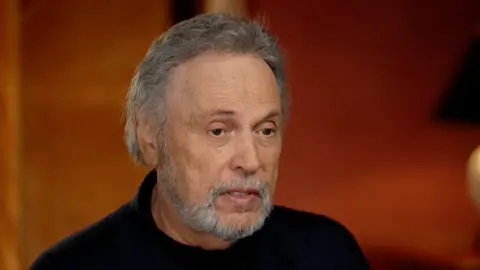
The Difference Between Belief and Reliance | Part One of Have We Created God in Our Own Image? A Sunday Morning That Changed My Thinking Billy Crystal did not say that God does not exist. He said, “I don’t trust Him. Too many bad things have happened.”¹ That distinction stopped me. On Sunday, October 11, I watched Tracy Smith interview Crystal about his new one-man Broadway show, 860. I had expected a conversation about acting, comedy, and the loss of his Pacific Palisades home in the January 2025 fire. Instead, the interview turned toward God—and toward a question many people may carry privately but rarely state plainly: What does it mean to believe in God if you no longer trust God to help you? Crystal was discussing 860, a show shaped by loss and other painful experiences. The conversation returned to 700 Sundays, his earlier one-man show about the limited number of Sundays he shared with his father before his father’s death. In that production, he had spoken about conversations with God. Smith asked whether he still talked to God. Crystal answered, “No, ’cause I don’t trust Him. Too many bad things have happened.”¹ I rewound the interview. Here was a man I have admired for years, a public figure known for warmth, humor, and humanity, saying on national television what many religious people might hesitate to say even in private. I was surprised by the statement, but I was also surprised by how quickly I understood it. Crystal was not necessarily denying God’s existence. He was describing a breakdown in reliance. He may still believe God is there; he no longer expects God to show up for him. Belief and trust are related, but they are not the same. Belief asks, Is God real? Trust asks, Can I depend on God when I need help? A person can answer the first question affirmatively and the second negatively. We understand that distinction in ordinary relationships. We may know that someone exists, recognize that person’s abilities, and remember that person’s past accomplishments, yet still decide not to rely on that person when circumstances become difficult. Knowledge of someone’s existence does not automatically produce confidence in that person’s dependability. Crystal is seventy-eight years old. That matters to me, not because age automatically produces wisdom, but because seventy-eight years contain enough experience to change what a person expects from life. Crystal has described losing his father when he was young, losing the home that held the memories of his family, and enduring the loss of people dear to him. He has also lived long enough to watch the people around him encounter experiences they would never have chosen. The statement I heard was not the challenge of a teenager casually rejecting an inherited belief. It sounded like the conclusion of someone whose expectations had been tested by a lifetime of loss. I do not know Billy Crystal personally. I cannot speak for the whole of his Jewish faith, his private beliefs, or what he intends for his relationship with God tomorrow. His interview does not give me that authority. I can say only what I heard: he did not say God does not exist. He said he does not trust God. That difference reaches far beyond one interview. It raises the central question of this essay: What happens when a person continues to believe in God but no longer relies on God for protection, intervention, or help? I have spent much of my life thinking about that question. I have experienced loss, served as a minister of the gospel, stood beside grieving families, and listened to people ask where God was when they needed Him. I have also watched the suffering of people I will never meet through the constant stream of news. These experiences have taught me that the crisis of faith is not always a crisis of belief. Sometimes it is a crisis of trust. That is the distinction I want to examine. What Experience Has Taught Me I have lost my father and my mother. My father died after living with heart disease and lung cancer. I have known people whose lives ended in automobile accidents and family members whose lives were overtaken by illness. A woman who once worked for me lost her life to domestic violence. These are not academic illustrations that I selected to make a philosophical argument more dramatic. They are part of the human experience through which I have come to understand grief, uncertainty, and the limitations of what we can control. I have never lost my home and everything in it to a fire, as Crystal and his family did. I cannot claim to know that particular experience. I can recognize the scale of such a loss, and I can understand why someone who has endured it might ask what became of the protection and help that people so often associate with God. I have also served as a minister of the gospel, and that responsibility has brought me into some of the most joyful and most difficult moments people experience. I have participated in weddings where families gathered with every expectation of a hopeful future, and I have conducted funerals where families struggled to understand how that future had changed so quickly. I have counseled people after acts of violence, including the needless loss of a young man and the killing of a spouse. I have listened to people whose circumstances were overturned by the loss of work, a home, or their health, and I have seen the grief that follows the death of a loved one. The prospect of losing a child may be among the most agonizing experiences a parent can contemplate, and I would never presume to explain that loss away with a convenient religious answer. In these circumstances, the question people bring to a minister is not always a technical question about doctrine. Often it is an earnest and bewildered question about why help did not come and