
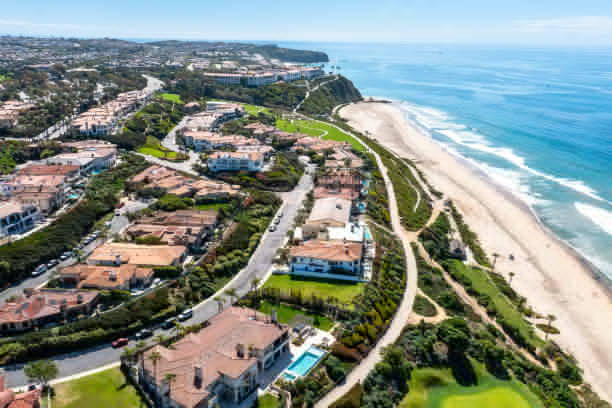
Orange County continues to stand as one of California’s most stable and high-value real estate markets, characterized by strong household incomes, consistent demand, and a long-standing reputation for residential desirability. Unlike more volatile regions, this county often moves at a measured pace, where pricing shifts are gradual and buyer behavior tends to be more financially conservative. In 2026, the housing landscape reflects a market that is neither sharply accelerating nor declining, but instead adjusting within a narrow band of equilibrium shaped by affordability constraints and limited supply.
What makes Orange County particularly distinct is the balance between its coastal luxury markets and its highly structured suburban communities. This balance creates a layered housing ecosystem where price sensitivity varies significantly across neighborhoods. As mortgage rates remain elevated compared to historical lows, buyers are increasingly selective, while sellers are holding firm on pricing expectations due to long-term equity positions.
This article breaks down the current Orange County real estate environment, focusing on pricing behavior, inventory conditions, buyer demand, and the evolving structure of transactions shaping the 2026 market cycle.
Market Pricing Behavior: Stability Within a High-Cost Corridor
Orange County’s housing market continues to operate within one of the highest price brackets in California, with median home values consistently exceeding $1.0 million in many submarkets. While price appreciation has slowed compared to previous cycles, the region has not experienced meaningful depreciation. Instead, the market is defined by price flattening and narrow movement ranges, where most annual changes remain within low single-digit percentages.
Recent county-level data shows that median sold prices have remained relatively steady, reflecting a market that is absorbing higher borrowing costs without significant downward corrections. The persistence of elevated pricing is largely supported by long-term homeowners with substantial equity positions, reducing the urgency to sell under less favorable conditions.
However, pricing behavior is not uniform. Coastal areas such as Newport Beach and Laguna Beach continue to demonstrate strong resistance to price softening, while inland submarkets show more negotiation flexibility. This creates a segmented pricing environment where micro-location matters more than broad countywide trends.
Inventory Conditions: Limited Supply Continues to Shape Competition
One of the defining characteristics of the Orange County housing market is its structurally constrained inventory. The number of active listings remains below historical norms, with supply levels typically ranging between two to three months of inventory, depending on seasonal cycles.
This limited availability continues to support price stability, even in the presence of softer demand conditions. Many homeowners are reluctant to list properties due to the “lock-in effect,” where existing low mortgage rates discourage movement. As a result, turnover remains low, reinforcing scarcity in both entry-level and mid-tier housing segments.
Properties that do enter the market tend to attract immediate attention if they are correctly priced. Homes in well-established school districts and commuter-friendly corridors often move faster than the county average, while overpriced listings remain on the market significantly longer. This dynamic highlights a market where pricing precision is becoming more important than ever.
Buyer Behavior: Selectivity Over Aggression
Buyer behavior in Orange County has shifted noticeably toward selective purchasing rather than competitive bidding wars. While demand remains structurally strong, the urgency seen in prior years has diminished due to affordability pressures and higher borrowing costs.
Many buyers are now prioritizing value alignment over speed, spending more time evaluating comparable properties and negotiating price adjustments. This has led to a rise in conditional offers and longer decision timelines, particularly in mid-range housing segments.
However, well-positioned properties in desirable neighborhoods continue to attract multiple offers. This indicates that demand has not weakened uniformly, but rather become more concentrated around specific price points and property characteristics. The result is a market where competition exists, but only within tightly defined segments.
Market Segmentation: Diverging Performance Across Price Tiers
Orange County’s real estate market is increasingly defined by tier-based performance differences. High-end luxury properties maintain relative stability due to wealth concentration and low sensitivity to interest rate fluctuations. Meanwhile, starter and mid-tier homes face more pricing pressure as affordability becomes a limiting factor for many households.
Luxury segments continue to see steady transaction volume, supported by equity-rich buyers and cash transactions. Mid-tier properties experience moderate appreciation or flat pricing, depending on location and condition. Entry-level housing, however, is more sensitive to economic shifts, with longer days on market and increased negotiation activity.
This segmentation reflects a broader structural shift in California housing markets, where affordability constraints are reshaping demand distribution across price bands rather than causing uniform market movement.
Rental Market Influence and Housing Pressure
The rental market in Orange County plays a significant role in shaping homeownership demand. Median rents remain among the highest in the state, frequently exceeding $2,800 to $3,500 per month depending on submarket and unit type.
This sustained rental pressure continues to push long-term renters toward homeownership when financially feasible. However, elevated home prices and higher mortgage costs have slowed this transition. As a result, rental demand remains strong, particularly among younger households and relocating professionals.
The interaction between high rental costs and constrained ownership affordability creates a dual-pressure environment, where both rental and purchase markets remain competitive, albeit for different reasons.
Orange County’s real estate market in 2026 reflects a landscape defined by stability, segmentation, and constrained supply. While price growth has slowed, the market has not entered a downturn. Instead, it is operating within a narrow band of equilibrium shaped by affordability limits and strong long-term equity positions.
For buyers, success in this market depends on timing, financial readiness, and precise property targeting. For sellers, accurate pricing and market positioning are essential, as overpricing can quickly reduce visibility in a selective buyer environment. Investors and market observers should focus less on broad countywide trends and more on neighborhood-level performance differences.
Thank you for taking the time to read and reflect. I write to help people think clearly about money, business, real estate, and life — not from theory, but from decades of lived experience.
If you are navigating a financial decision, building a business, considering homeownership, or simply trying to make better use of your time and resources, I invite you to engage further.
Subscribe to The Power Is Now TV to connect with me live every weekday, Monday through Friday, from 10:00 AM to 11:00 AM PST, as we record television shows across the Power Is Now TV Network. As a subscriber, you can participate in live tapings, engage in real-time discussions, and connect directly with industry leaders.
Visit ThePowerIsNow.com to access real estate magazines, books, podcasts, television shows, and exclusive media content focused on homeownership, business, and wealth-building.
For personalized support, consulting, and advisory services in real estate, mortgages, business, and personal finance, visit EricFrazier.com to schedule a consultation and learn more about my work as your trusted advisor in business and wealth.
Eric Lawrence Frazier, MBA
Your trusted advisor in business and wealth
www.ericfrazier.com | www.thepowerisnow.com
NMLS #461807 | CA DRE #01143484
Schedule a consultation: https://calendly.com/ericfrazier/real-estate-mortgage-consultation-clients
References
California Association of Realtors. (2026). Statewide housing market trends report. https://www.car.org/aboutus/mediacenter/newsreleases
U.S. Census Bureau. (2026). American Community Survey: Orange County housing characteristics. https://www.census.gov/programs-surveys/acs
U.S. Department of Housing and Urban Development. (2026). Housing market indicators and affordability data. https://www.huduser.gov/portal/datasets/hads.html