
I. The Cultural Diagnosis: From the Ministry of the Church to the Ministry of the Home
For over four decades, my life was anchored in public ministry. For more than thirty of those years, I carried a demanding dual existence: serving full-time in pastoral leadership while simultaneously operating full-time in banking, mortgage underwriting, and real estate brokerage. I spent thousands of hours at the pulpit, preparing Bible studies, and teaching Sunday mornings, Sunday nights, and midweek services. Serving others, dissecting complex truths, and leading people through crisis is woven into my very DNA.
Eventually, maintaining both full-time tracks at maximum intensity became an unsustainable drain on time and energy. But my ministry never ended; it evolved. I shifted my focus from the ministry of the church to the ministry of the home.
Looking back on those early decades, I carry a profound, unvarnished regret. While I was out pastoring, preaching, and working twelve-hour days, I unintentionally neglected my own household’s operational governance. Because I earned enough income for my wife to be a full-time mother and caretaker, I operated under the flawed assumption that my physical presence and active oversight in daily financial management were unnecessary. I left the entire burden of managing bills, tracking obligations, balancing accounts, and maintaining our long-term balance sheet squarely on her shoulders. That was not only unfair—it was an abdication of leadership.
I see this exact failure playing out across America today in the lives of young couples, both inside and outside the church. Husbands work grueling hours, return home with zero mental or emotional bandwidth, and surrender all financial governance to their spouses. Then, when cash flow turns negative and debt accumulates, frustration, resentment, and blame erupt. The statistics are unequivocal: financial stress, opacity, and mismanagement remain the leading catalysts for marital dissolution in the United States.
Managing a household’s balance sheet, savings goals, and risk mitigation cannot be a solo administrative chore delegated out of exhaustion. It is a joint strategic obligation. The home is not subordinate to public ministry, executive status, or career ambition—it is the foundational institution. Without structural stability at home, every external endeavor rests on sand.
The School of Hard Knocks
I speak from raw experience, having walked the exact road my clients navigate. In 1981, at the tender age of nineteen, I married my wife. I moved directly from my father’s house into our first home; my wife moved directly from her mother’s house into ours. Neither of us had ever lived independently. We were thrown into the deep end of the economic ocean and forced to sink or swim. We possessed zero functional knowledge of zero-based budgeting, capital preservation, liquidity management, or the predatory mechanics of consumer credit.
Necessity became the mother of invention, and we made a devastating number of mistakes. Thinking back on those early missteps still evokes a sharp memory of anxiety. But problems do not last forever, and I anchored my mindset in a enduring truth: This too shall pass.
A firm spiritual foundation provided the resilience required to weather those storms. Operating in faith taught me that failure was never an option so long as I recognized God as my ultimate source of strength and wisdom. He equipped us with intellect, agency, and capacity—promising never to allow a trial beyond what could be endured with discipline and resolve. Understanding how to recover from bad decisions forged the resilience necessary to graduate from the School of Hard Knocks, build a multi-decade career in financial services, and lead others out of the same traps.
In my years reviewing credit applications as an underwriter, stepping in as a branch manager to resolve failing transactions, and watching real estate deals collapse at the closing table, I have identified one constant, destructive thread: unmanaged, addictive consumer debt.
II. The Macroeconomic Trap: A Nation Enslaved to Credit
When you examine the macroeconomic indicators across the United States, the scale of consumer indebtedness reflects a profound cultural disease:
- Total National Household Debt: Exceeds $17.5 trillion.
- Mortgage Debt: Surpasses $12.5 trillion.
- Credit Card Debt: Tops $1.1 trillion, with average APRs hovering near historic highs above 21%.
- Auto Loan Debt: Exceeds $1.6 trillion.
- Student Loan Debt: Approaching $1.6 trillion.
Looking at these numbers daily forces a sobering diagnosis: Modern culture no longer knows how to exist without owing somebody money.
We no longer understand how to enjoy leisure without financing vacations on revolving credit. We no longer understand how to pursue higher education without signing away decades of future income to student loans. We do not buy vehicles based on purchase price, but on monthly installment terms, and we swipe credit cards for daily apparel and groceries. Millions of consumers are addicted to debt—or completely enslaved by it. A significant portion of the population simply does not generate sufficient free cash flow to service their debt under prevailing interest rates. Meanwhile, high earners routinely fall off the wagon due to impulse consumption, status signaling, and the rat race of keeping up with the Joneses. They operate under a dangerous delusion: “I’ll put it on the card and figure it out later.”
That mindset leads directly to structural financial ruin.
Without liquid capital reserves, most American families are precisely one or two missed paychecks away from insolvency. The paycheck arrives on the 1st and is exhausted by the 5th; the next arrives on the 15th and is gone by the 20th. Bank accounts have become temporary transit stations for creditors rather than vaults for wealth accumulation. When economic shocks hit—income disruptions, job eliminations, medical emergencies, or the relentless drag of inflation on food, fuel, and utilities—these households have zero cushion.
Consequently, millions of families who dream of homeownership will never achieve it because they cannot accumulate down payment capital. Even if they received a sudden windfall, their lack of discipline and systemic reliance on credit would make sustaining a 30-year mortgage nearly impossible. Homeownership requires a conservative, risk-mitigated approach to capital management. It demands eliminating consumer debt, understanding credit structures, and building genuine liquidity.
III. The Theological Reality Check: Faith Is Not a Substitute for Strategy
Because a significant segment of my clientele consists of people of faith, I frequently confront a widespread, toxic tendency: the over-spiritualization of practical financial negligence. People routinely pray for God to solve crisis scenarios created entirely by their own unforced errors. They do not explicitly state that God caused their debt, but their prayers betray their mindset: “Lord, I know You didn’t put me in this debt, but I need You to deliver me, pay my back rent, cover my car payment, and restore my bank account in Jesus’ name, Amen.”
This over-spiritualized narrative is an admission that an individual has exhausted their ideas—or worse, that they know the hard, uncomfortable decisions required to fix the problem, but refuse to make them. They refuse to cut their lifestyle. They refuse to endure the temporary social embarrassment of downsizing their home, selling the luxury vehicle they cannot afford, or telling their peer group “no.” They choose passive religious performance over operational accountability. Having spent my entire life in pastoral leadership, let me state this truth without apology: Hope and prayer is not a financial strategy.
In fact, hoping and praying while refusing to take responsibility is an exercise in self-deception. The first mandate of faith is not passive waiting; it is decisive, disciplined action. You must audit your balance sheet, stop the financial bleeding, seek high-level counsel, and execute hard choices. God honors order, structure, and stewardship—not chaos. Praying for a financial miracle while refusing to discipline your spending is asking God to endorse your negligence. God is not going to descend from the heavens to pay off credit card balances while you sit idle. He granted you free agency, intellect, and access to resources. Wisdom is sitting directly in front of you—demanding that you act.
IV. The Empirical Breakdown: Mechanics and Realities of the Debt Snowball
To address consumer debt, financial commentators promote various tactical frameworks—including the Debt Avalanche, Debt Consolidation Loans, 0% Balance Transfer Offers, and Micro-payments (Debt Snowflakes). (I explore these strategies in depth in my forthcoming book, Debt Management.)
Among behavioral strategies, none commands more mindshare than The Debt Snowball.
The Tactical Mechanics
Popularized in the 1990s by Dave Ramsey through Financial Peace University, the Debt Snowball prioritizes human psychology over mathematical optimization.
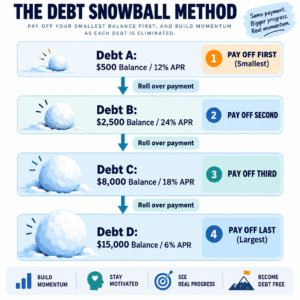
- Inventory all non-mortgage liabilities from smallest balance to largest balance, completely disregarding interest rates (APRs).
- Maintain minimum required payments on every account except the smallest balance.
- Direct all available free cash flow aggressively toward the smallest balance until it is eliminated.
- Roll over the total monthly amount previously paid toward the cleared account (minimum payment plus extra cash) into the payment budget for the next-smallest balance.
- Repeat the process, allowing the rolling payment budget to “snowball” into a larger debt-reduction allocation with each cleared balance.
Academic Validation: The 2012 Gal & McShane Study
Proponents of the Snowball method cite empirical research to defend ignoring APR calculations. The primary academic anchor for this approach is the landmark 2012 study by Dhar Jay Gal and Blakeley McShane, published in the Journal of Marketing Research: Gal, D., & McShane, B. (2012). “Can Small Victories Help Win War? Evidence from Consumer Debt Settlement.”
- Study Methodology: Gal and McShane analyzed proprietary transactional data from a major debt settlement firm, tracking thousands of consumers across multi-account debt management programs to isolate the behavioral impact of complete account closures versus total balance reductions.
- Core Findings: The researchers established that closing individual accounts—regardless of balance size or interest rate—had a statistically significant positive association with a client’s probability of completing their debt elimination program. Eliminating discrete liabilities increases a consumer’s sense of self-efficacy, generating psychological momentum that improves program adherence.
- The Behavioral Argument: For many consumers, psychological wins provide a more effective adherence mechanism than pure interest-rate optimization.
Critical Research Limitations
While Gal & McShane validated the motivational benefit of “small victories,” financial media often misapplies their findings. Key contextual limitations must be acknowledged:
- Supervised Program Bias: The study evaluated consumers enrolled in formal debt-settlement programs, meaning participants were already operating under third-party oversight, structured payment terms, and professional counseling. It did not prove that self-directed borrowers succeed using the Snowball method in isolation.
- Absence of Post-Repayment Tracking: The study did not track participants three to five years post-repayment to evaluate whether they sustained debt freedom or returned to revolving credit usage.
- The Mathematical Penalty: By ignoring APRs, a borrower prioritizing a $300 balance at 4% interest leaves a $10,000 balance at 28% interest compounding rapidly. This “interest drag” increases total out-of-pocket capital expenditures and extends the overall repayment timeline.
- Zero Impact on Liquidity or Behavior: The Debt Snowball merely rearranges debt payments. It does not generate new income, curb underlying impulse spending, or construct emergency liquidity reserves. If an unexpected emergency occurs mid-snowball, a household without cash reserves is forced to re-swipe its newly cleared credit accounts, resetting their progress.
V. The Leadership Mandate: Why Blueprints Fail Without Execution and Coaching
The empirical literature confirms that momentum matters, and the Debt Snowball offers a clear tactical framework. Yet, no repayment tactic—whether Snowball, Avalanche, or Consolidation—functions as a standalone solution without coaching, accountability, and structural change. Every debt payoff strategy contains inherent trade-offs:
- The Snowball increases total lifetime interest costs.
- The Avalanche demands exceptional discipline when the highest-APR account carries a large balance that takes months or years to eliminate.
- Consolidation Loans shift the location of liabilities without altering spending habits, frequently leading borrowers to accumulate new balances on cleared credit cards.
A tactic is merely a blueprint. A blueprint has never built a house; it requires a master builder on-site enforcing standards, checking measurements, and holding every wall to the plumb line. Look at elite athletic performance. Every Olympic champion and professional athlete operates under the direct supervision of a dedicated coach. They do not hire coaches because they lack technical talent; they hire coaches because. Accountability produces peak performance. A skilled coach identifies blind spots, corrects technical errors, enforces adherence when motivation vanishes, and keeps the athlete aligned with their ultimate objectives.
Motivation is emotional and temporary; executive coaching builds the operational systems that produce permanent financial freedom.
Thank you for taking the time to read and reflect. I write to help people think clearly about money, business, real estate, and life — not from theory, but from decades of lived experience.
If you are navigating a financial decision, building a business, considering homeownership, or simply trying to make better use of your time and resources, I invite you to engage further.
Subscribe to The Power Is Now TV to connect with me live every weekday, Monday through Friday, from 10:00 AM to 11:00 AM PST, as we record television shows across the Power Is Now TV Network. As a subscriber, you can participate in live tapings, engage in real-time discussions, and connect directly with industry leaders.
Visit ThePowerIsNow.com to access real estate magazines, books, podcasts, television shows, and exclusive media content focused on homeownership, business, and wealth-building.
For personalized support, consulting, and advisory services in real estate, mortgages, business, and personal finance, visit EricFrazier.com to schedule a consultation and learn more about my work as your trusted advisor in business and wealth.
Eric Lawrence Frazier, MBA
Your trusted advisor in business and wealth
www.ericfrazier.com | www.thepowerisnow.com
NMLS #461807 | CA DRE #01143484
Schedule a meeting: https://www.ericfrazier.com
Copyright © 2026 Eric Lawrence Frazier. All rights reserved. This article may be republished or syndicated with appropriate attribution and retention of author credentials and booking links.