
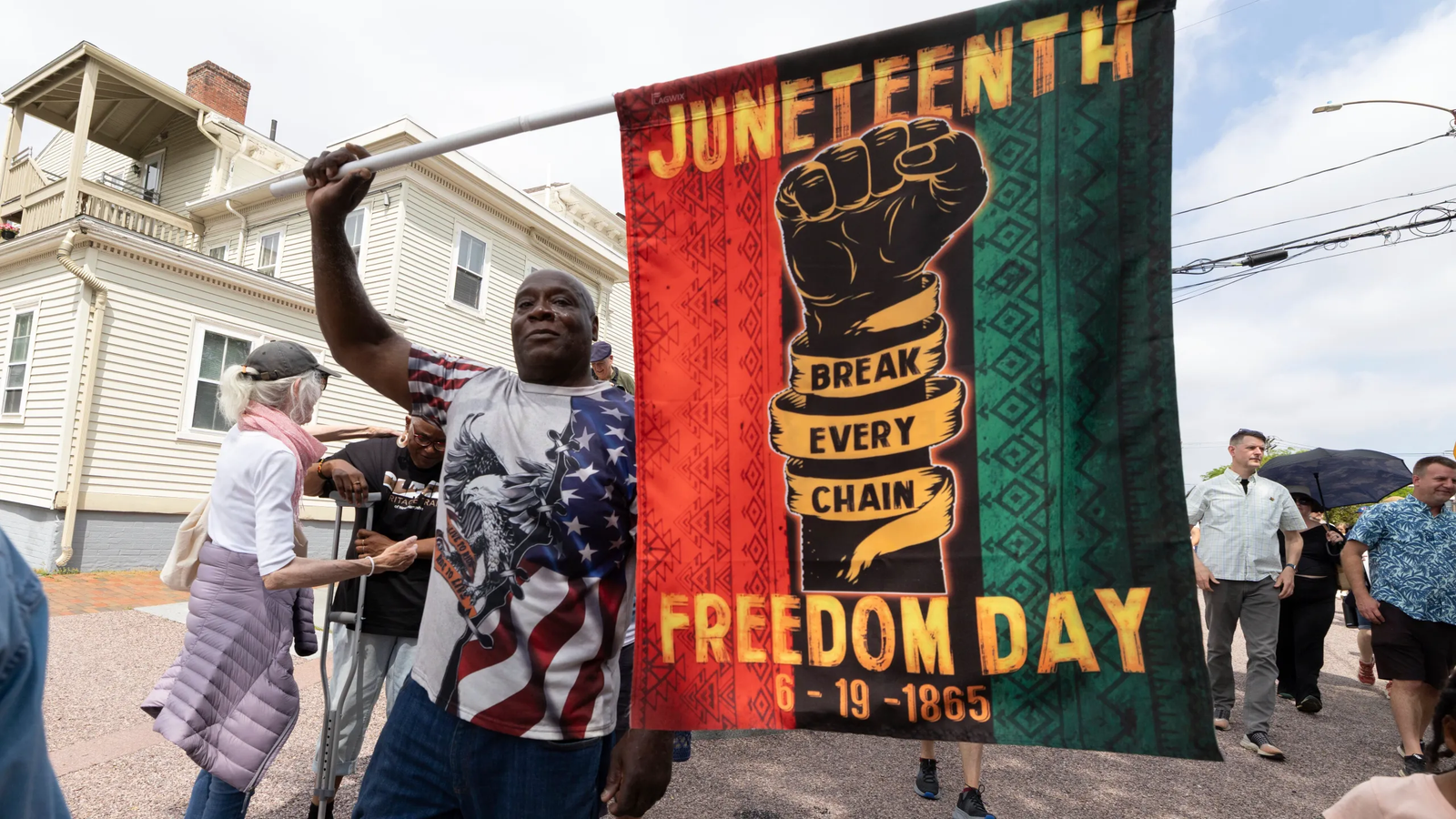
From Juneteenth ice cream to pulled sponsorships, how the market turned emancipation into a product, then abandoned it when it became inconvenient
America has a well-established tradition of taking its most sacred and historically weighted moments and turning them into merchandise. Christmas became a retail season. Martin Luther King Jr.’s legacy became a mattress sale. Memorial Day became a car dealership event. So perhaps no one should have been surprised when Juneteenth, the commemoration of the end of slavery, barely survived its first year as a federal holiday before corporations figured out how to put it on a label and charge $4.99 for it. What is surprising, and worth examining carefully, is how quickly those same corporations abandoned it the moment supporting it stopped being profitable.
The arc of corporate America’s relationship with Juneteenth, from enthusiastic monetization, to viral humiliation, to quiet withdrawal, tells you more about how businesses actually view Black history than any press release ever could.
Year One: The Rush to Capitalize
The Juneteenth National Independence Day Act was signed on June 17, 2021. Corporate America moved with unusual speed. Within twelve months, the holiday that Black communities had observed quietly for over 150 years had become a product category. The share of large employers offering Juneteenth as a paid holiday rose from 9% in 2021 to about 33% in 2022, then 39% in 2023, and 41% in 2024. Companies announced solidarity statements. Retailers stocked themed merchandise. It looked, on the surface, like a moment of genuine recognition.
Then the products started appearing on shelves and the problems became impossible to ignore.
Walmart introduced a “Celebration Edition: Juneteenth Ice Cream,” a red velvet and cheesecake flavor, with a label reading “Share and celebrate African-American culture, emancipation and enduring hope.” After a firestorm of criticism on social media calling the item “tone deaf,” Walmart pulled the product and issued an apology. The backlash was swift and pointed. One widely shared tweet cut straight to the issue: “We said REPARATIONS… not Red Velvet.” Dollar Tree also faced backlash for promoting a Juneteenth-inspired line of party supplies and tableware using the Pan-African colors of green, red, and yellow, rather than the actual Juneteenth colors of red, white, and blue, suggesting the team behind the product had not researched even the basic symbolism of the holiday they were selling.
But Walmart and Dollar Tree were not alone. Microsoft-owned 343 Industries renamed an emblem in its Halo Infinite video game meant to celebrate Juneteenth that had initially been labeled “Bonobo,” the name of a great ape, only changing it to “Freedom” after social media backlash. The Children’s Museum of Indianapolis also expressed regret for selling a “Juneteenth watermelon salad,” which was called out for invoking a longstanding racist stereotype.
In the space of one June, corporate America had managed to package the emancipation of enslaved people alongside a great ape reference, a racist food trope, and wrong-colored party napkins. If it were a coordinated effort to demonstrate how little these companies actually knew about the history they claimed to be honoring, it could hardly have been more effective.
The Pattern Keeps Repeating
One might expect that after the public humiliations of 2022, major retailers would approach the following years with more care. The evidence suggests otherwise.
In 2025, a Kroger store in Atlanta went viral when a TikTok user posted video of the store’s Juneteenth cookie cakes featuring sloppily piped slogans like “June 19 FREE” and “Free @ Last.” The video garnered over 7 million views. Critics pointed out that “Free at Last” is a direct lift from the closing words of Dr. Martin Luther King Jr.’s “I Have a Dream” speech, itself drawn from a classic Negro spiritual, truncated to a casual “@” sign and scrawled across a dessert.
Kroger’s response was to remove the cakes but not to replace them with anything more thoughtful. The company cited “quality control” failures, a framing that missed the point entirely: the problem was not the execution but the conception.
Three years of corporate Juneteenth missteps, same companies, same basic failure, same cycle of backlash and apology, tells you this is not a series of individual mistakes. It is systemic. As several social justice and public policy experts have pointed out, the sudden commercial recognition of a holiday Black families have been celebrating for more than 160 years misses its historical importance. It would be more meaningful to see corporations create scholarship funds, sponsor anti-racism public service announcements, or review and address corporate policies that inhibit diverse hiring. Instead, the response has been paper plates and cookie cakes.
The Expert Verdict
The academic community has been consistent on what corporate Juneteenth behavior actually reveals. According to William Darity, a public policy professor at Duke University and racial equity expert, once any significant event is declared a national holiday it becomes subject to potential commercialization. He added that Juneteenth’s national acknowledgement, ironically, may take away from “the compelling need for a comprehensive national program for Black American reparations.” “Imagine how different the landscape would look if Juneteenth had been designated as a federal holiday after reparations had been paid,” he said.
That framing is important. The holiday itself, in this reading, functions as a substitute, a symbolic acknowledgment that corporations and politicians can point to as evidence of progress, while the structural and economic inequities that Juneteenth actually represents remain entirely unaddressed. Turning the history of slavery into paper plates and limited-edition ice cream reduces the long, painful, complicated journey of African American people into a comfortably consumable commodity. It also implies that journey is over, that Black people in the United States have reached a place of freedom and equality. As we know, this is not true.
The Fastest U-Turn in Corporate History
If years two, three, and four of corporate Juneteenth were defined by clumsy product launches, year five revealed something arguably more damaging: how conditional that corporate support had been all along.
Denver’s Juneteenth Music Festival, a cornerstone celebration of Black liberation in the historically Black Five Points neighborhood, was reduced from a two-day event to a single day in 2025 due to a more than 60% drop in corporate sponsorship, leaving an $80,000 funding gap even for the scaled-back event. Executive Director Norman Harris attributed the shortfall to “shifting corporate priorities.”
That phrase, “shifting corporate priorities,” deserves translation. Companies and municipalities across the country reconsidered their support for Juneteenth celebrations as the Trump administration’s rollback of DEI programs gained momentum. In Scottsdale, Arizona, city council members dissolved their DEI office in February, which directly led to the cancellation of the city’s annual Juneteenth festival. In Colorado Springs, around five companies sponsored the Juneteenth event compared to dozens in prior years, with organizers reporting that sponsors explicitly said their budgets had been cut because of DEI.
Norman Harris, who has been organizing Denver’s Juneteenth Music Festival for over a decade, called 2025 the “most challenging” year he had faced, with 12 major corporate sponsors pulling their support over just a couple of months. The same companies that had rushed to associate their brands with Juneteenth when it was a visible expression of social solidarity were among the first to disappear when that solidarity became politically risky.
What This Cycle Actually Tells Us
It is easy for companies to brainstorm themed products for celebrations like Juneteenth or proclaim support on social media, but much harder to do the actual work of reckoning with the history and pain that made these momentous dates significant. The commercialization to abandonment cycle that has defined corporate America’s relationship with Juneteenth since 2021 is not a paradox. It is entirely logical, if you understand that for most of these companies, the holiday was never really about emancipation. It was about brand positioning.
When positioning themselves with Juneteenth was good for business, when the social moment after George Floyd’s murder made solidarity statements safe and even commercially advantageous, companies invested. When positioning shifted, when supporting DEI became politically fraught, when the cost-benefit calculation changed, they pulled the sponsorships, cleared the shelves, and moved on.
Juneteenth was made a federal holiday in 2021, and since then, American companies have quickly moved to profit by selling new goods and services targeted to Black consumers. While those businesses look to make money, the newly recognized federal holiday ought to serve as an opportunity for all Americans to acknowledge and pursue redress for the centuries of economic exploitation of Black people and the continuing impact of economic inequality.
The most honest read of corporate America’s Juneteenth journey is this: they arrived when the cameras were on, made a mess, apologized publicly, made the same mess again the following year, and then left entirely when it stopped being convenient. The communities that had been celebrating this holiday in church halls and family backyards for 160 years before any corporation noticed? They are still there. And Juneteenth will still be there too, with or without the ice cream.
Thank you for taking the time to read and reflect. I write to help people think clearly about money, business, real estate, and life, not from theory, but from decades of lived experience.
If you are navigating a financial decision, building a business, considering homeownership, or simply trying to make better use of your time and resources, I invite you to engage further.
Subscribe to The Power Is Now TV to connect with me live every weekday, Monday through Friday, from 10:00 AM to 11:00 AM PST, as we record television shows across the Power Is Now TV Network. As a subscriber, you can participate in live tapings, engage in real-time discussions, and connect directly with industry leaders.
Visit ThePowerIsNow.com to access real estate magazines, books, podcasts, television shows, and exclusive media content focused on homeownership, business, and wealth-building.
For personalized support, consulting, and advisory services in real estate, mortgages, business, and personal finance, visit EricFrazier.com to schedule a consultation and learn more about my work as your trusted advisor in business and wealth.
Eric Lawrence Frazier, MBA
Your trusted advisor in business and wealth
www.ericfrazier.com | www.thepowerisnow.com
NMLS #461807 | CA DRE #01143484
Schedule a consultation: https://calendly.com/ericfrazier/real-estate-mortgage-consultation-clients
References
Ainvest. (2025, June 20). The Juneteenth cake controversy: Kroger’s PR crisis and the rising stakes of corporate social responsibility in retail. https://www.ainvest.com/news/juneteenth-cake-controversy-kroger-pr-crisis-rising-stakes-corporate-social-responsibility-retail-2506/
Blain, K. N. (2022, June 21). Juneteenth commercialization is already out of hand. MSNBC. https://www.msnbc.com/opinion/msnbc-opinion/commercialization-juneteenth-already-out-hand-n1296444
Bove, T. (2022, May 24). Walmart pulls its Juneteenth ice cream after major backlash. Fortune. https://fortune.com/2022/05/24/walmart-juneteenth-ice-cream-backlash-apology
CultureAlly. (2025). How to celebrate Juneteenth at work. https://www.cultureally.com/blog/how-to-celebrate-juneteenth-at-work
eMarketer. (2022). Brands land in hot water for Juneteenth marketing miscues. Insider Intelligence. https://www.emarketer.com/content/brands-land-hot-water-juneteenth-marketing-miscues
Francis, M. (2022, May 28). ‘We received feedback’: The commercialization of Juneteenth backfires for big brands. Samuel DuBois Cook Center on Social Equity, Duke University. https://socialequity.duke.edu/?p=10270
Lathan, N., & The Associated Press. (2025, June 16). Juneteenth celebrations adapt after corporate sponsors pull support. U.S. News & World Report. https://www.usnews.com/news/us/articles/2025-06-16/juneteenth-celebrations-adapt-after-corporate-sponsors-pull-support