
The Votings Right Act Part 3: When Race Becomes Politics – Footnotes
U.S. Department of Justice. “About Section 5 of the Voting Rights Act.”https://www.justice.gov/crt/about-section-5-voting-rights-act Supreme Court of the United States. Shelby County v. Holder, 570 U.S. 529 (2013).https://www.supremecourt.gov/opinions/12pdf/12-96_6k47.pdf Pew Research Center. “Partisanship by Race, Ethnicity and Education.” 2024.https://www.pewresearch.org/politics/2024/04/09/partisanship-by-race-ethnicity-and-education/ NAACP. “NAACP Files Federal Lawsuit Challenging Tennessee’s Racially Discriminatory Congressional Map.” 2026.https://naacp.org/articles/naacp-files-federal-lawsuit-challenging-tennessees-racially-discriminatory-congressional Supreme Court of the United States. Louisiana v. Callais (2026).https://www.supremecourt.gov/opinions/25pdf/24-109_21o3.pdf U.S. Department of Justice. “About Section 5 of the Voting Rights Act.”https://www.justice.gov/crt/about-section-5-voting-rights-act Supreme Court of the United States. Shelby County v. Holder.https://www.supremecourt.gov/opinions/12pdf/12-96_6k47.pdf Pew Research Center. “Partisanship by Race, Ethnicity and Education.”https://www.pewresearch.org/politics/2024/04/09/partisanship-by-race-ethnicity-and-education/ NAACP. “NAACP Files Federal Lawsuit Challenging Tennessee’s Congressional Map.”https://naacp.org/articles/naacp-files-federal-lawsuit-challenging-tennessees-racially-discriminatory-congressional
The Voting Rights Act Part 2: Have We Forgotten Why the Voting Rights Act Exists? – Footnotes
Rothstein, R. (2017). The color of law: A forgotten history of how our government segregated America. W. W. Norton & Company. Voting Rights Act of 1965, 52 U.S.C. § 10301 (1965).https://www.archives.gov/milestone-documents/voting-rights-act History.com Editors. (n.d.). Selma to Montgomery march.https://www.history.com/topics/black-history/selma-montgomery-march U.S. Department of Justice. (n.d.). History of federal voting rights laws.https://www.justice.gov/crt/history-federal-voting-rights-laws Library of Congress. (n.d.). Fifteenth Amendment to the U.S. Constitution.https://www.loc.gov/rr/program/bib/ourdocs/15thamendment.html Shelby County v. Holder. (2013). Oyez.https://www.oyez.org/cases/2012/12-96 Brnovich v. Democratic National Committee. (2021). Oyez.https://www.oyez.org/cases/2020/19-1257 Lyndon B. Johnson. (1965). The American Promise speech.https://www.lbjlibrary.org/learn/about-lbj/american-promise
THE END OF AN ERA: Part One – Footnotes
Callais and the Quiet Burial of the Voting Rights Act 1. Louisiana v. Callais, slip opinion, 608 U.S. ___ (Apr. 29, 2026), https://www.supremecourt.gov/opinions/25pdf/24-109_21o3.pdf; SCOTUSblog case page, https://www.scotusblog.com/cases/louisiana-v-callais/; Amy Howe, “In major Voting Rights Act case, Supreme Court strikes down redistricting map challenged as racially discriminatory,” SCOTUSblog, April 29, 2026, https://www.scotusblog.com/2026/04/in-major-voting-rights-act-case-supreme-court-strikes-down-redistricting-map-challenged-as-racia/. 2. Richard L. Hasen, “Callais: SCOTUS’ Voting Rights Act ruling is the worst decision in a century,” Slate, April 29, 2026, https://slate.com/news-and-politics/2026/04/scotus-voting-rights-section-two-ruling-history-worst-century.html. 3. Richard L. Hasen, “The Slaying of the Voting Rights Act by the Coward Samuel Alito,” Slate, April 30, 2026, https://slate.com/news-and-politics/2026/04/supreme-court-analysis-coward-samuel-alito-callais.html. See also Mary Louise Kelly interview with Hasen, “After Supreme Court ruling, what’s the future of the Voting Rights Act?” NPR All Things Considered, April 29, 2026, https://www.npr.org/2026/04/29/nx-s1-5804515/after-supreme-court-ruling-whats-the-future-of-the-voting-rights-act; “‘If You Can Keep It’: The Supreme Court And The Voting Rights Act,” NPR 1A, May 4, 2026, https://www.npr.org/2026/05/04/nx-s1-5810197/if-you-can-keep-it-the-supreme-court-and-the-voting-rights-act. 4. Voting Rights Act of 1965, 52 U.S.C. § 10301 et seq.; National Archives Milestone Documents, https://www.archives.gov/milestone-documents/voting-rights-act. 5. Shelby County v. Holder, 570 U.S. 529 (2013), Cornell LII, https://www.law.cornell.edu/supremecourt/text/12-96; Justia, https://supreme.justia.com/cases/federal/us/570/529/. 6. Thornburg v. Gingles, 478 U.S. 30 (1986), Cornell LII, https://www.law.cornell.edu/supremecourt/text/478/30; Justia, https://supreme.justia.com/cases/federal/us/478/30/. 7. Mobile v. Bolden, 446 U.S. 55 (1980), Cornell LII, https://www.law.cornell.edu/supremecourt/text/446/55; Justia, https://supreme.justia.com/cases/federal/us/446/55/. 8. Rucho v. Common Cause, 588 U.S. ___ (2019), Justia, https://supreme.justia.com/cases/federal/us/588/18-422/. 9. Students for Fair Admissions, Inc. v. President and Fellows of Harvard College, 600 U.S. 181 (2023), Cornell LII, https://www.law.cornell.edu/supremecourt/text/20-1199; Justia, https://supreme.justia.com/cases/federal/us/600/20-1199/. 10. Civil Rights Cases, 109 U.S. 3 (1883), Cornell LII, https://www.law.cornell.edu/supremecourt/text/109/3; Justia, https://supreme.justia.com/cases/federal/us/109/3/. 11. Plessy v. Ferguson, 163 U.S. 537 (1896), Cornell LII, https://www.law.cornell.edu/supremecourt/text/163/537. 12. C. Vann Woodward, Reunion and Reaction: The Compromise of 1877 and the End of Reconstruction (Boston: Little, Brown, 1951; rev. ed., New York: Oxford University Press, 1991), ISBN 9780195064230. See also Joseph Crespino, In Search of Another Country: Mississippi and the Conservative Counterrevolution (Princeton: Princeton University Press, 2007), ISBN 9780691122090, on the longer arc of southern political accommodation and its national consequences. 13. Edward E. Baptist, The Half Has Never Been Told: Slavery and the Making of American Capitalism (New York: Basic Books, 2014), ISBN 9780465049660. The $3.5 billion 1860 valuation and its share of GDP are widely documented in the slavery-and-capitalism literature, including Baptist. 14. District of Columbia Compensated Emancipation Act of April 16, 1862, National Archives Featured Document, https://www.archives.gov/exhibits/featured-documents/dc-emancipation-act; primary text and commission records, U.S. Senate, https://www.senate.gov/artandhistory/history/common/civil_war/DCEmancipationAct_FeaturedDoc.htm. 15. Richard Rothstein, The Color of Law: A Forgotten History of How Our Government Segregated America (New York: Liveright / W. W. Norton, 2017), ISBN 978-1-63149-285-3, ch. 4 on FHA underwriting. 16. Ira Katznelson, When Affirmative Action Was White: An Untold History of Racial Inequality in Twentieth-Century America (New York: W. W. Norton, 2005), ISBN 978-0-393-05213-8. 17. Aditya Aladangady, Andrew C. Chang, and Jacob Krimmel, “Greater Wealth, Greater Uncertainty: Changes in Racial Inequality in the Survey of Consumer Finances,” FEDS Notes, Board of Governors of the Federal Reserve System, October 18, 2023, https://www.federalreserve.gov/econres/notes/feds-notes/greater-wealth-greater-uncertainty-changes-in-racial-inequality-in-the-survey-of-consumer-finances-20231018.html. 18. H.R. 40, Commission to Study and Develop Reparation Proposals for African Americans Act, first introduced in the 101st Congress (1989) by Rep. John Conyers (D-MI), reintroduced in every Congress since; bill history, https://www.congress.gov/. 19. Executive Order 14151, “Ending Radical and Wasteful Government DEI Programs and Preferencing,” 90 Fed. Reg. 8339 (Jan. 29, 2025), https://www.federalregister.gov/documents/2025/01/29/2025-01953/ending-radical-and-wasteful-government-dei-programs-and-preferencing. 20. Executive Order 14173, “Ending Illegal Discrimination and Restoring Merit-Based Opportunity,” 90 Fed. Reg. 8633 (Jan. 31, 2025), https://www.federalregister.gov/documents/2025/01/31/2025-02097/ending-illegal-discrimination-and-restoring-merit-based-opportunity. 21. Executive Order 14160, “Protecting the Meaning and Value of American Citizenship,” January 20, 2025, American Presidency Project, https://www.presidency.ucsb.edu/documents/executive-order-14160-protecting-the-meaning-and-value-american-citizenship. 22. Executive Order 14281, “Restoring Equality of Opportunity and Meritocracy,” 90 Fed. Reg. 17537 (Apr. 28, 2025), https://www.federalregister.gov/documents/2025/04/28/2025-07378/restoring-equality-of-opportunity-and-meritocracy. 23. Memorandum from Attorney General Pam Bondi to All Department of Justice Employees, “Ending Illegal DEI and DEIA Discrimination and Preferences,” February 5, 2025, U.S. Department of Justice, Office of the Attorney General, https://www.justice.gov/ag/media/1388501/dl?inline=. 24. Memorandum from Charles Ezell, Acting Director, U.S. Office of Personnel Management, to Heads and Acting Heads of Departments and Agencies, “Initial Guidance Regarding DEIA Executive Orders,” January 21, 2025, https://www.opm.gov/media/e1zj1p0m/opm-memo-re-initial-guidance-regarding-deia-executive-orders-1-21-2025-final.pdf. 25. U.S. Department of Justice, Office of Public Affairs, “Department of Justice Terminates Environmental Justice Settlement Agreement, Advancing President Trump’s Mandate to End Illegal DEI and Environmental Justice Policies,” April 11, 2025, https://www.justice.gov/opa/pr/department-justice-terminates-environmental-justice-settlement-agreement-advancing-president. 26. U.S. Department of Housing and Urban Development, “Affirmatively Furthering Fair Housing Revisions,” Interim Final Rule, 90 Fed. Reg. 11006 (Mar. 3, 2025), https://www.federalregister.gov/documents/2025/03/03/2025-03360/affirmatively-furthering-fair-housing-revisions. 27. U.S. Department of Housing and Urban Development, “HUD’s Implementation of the Fair Housing Act’s Disparate Impact Standard,” Proposed Rule, 91 Fed. Reg. 1700 (Jan. 14, 2026), https://www.federalregister.gov/documents/2026/01/14/2026-00590/huds-implementation-of-the-fair-housing-acts-disparate-impact-standard. 28. National Fair Housing Alliance, “House Appropriations Committee’s Cuts to Fair Housing Funding Leaves Disabled Veterans, Seniors, and Others Unprotected from Housing Discrimination,” https://nationalfairhousing.org/house-appropriations-committees-cuts-to-fair-housing-funding-leaves-disabled-veterans-seniors-and-others-unprotected-from-housing-discrimination/. 29. Office of the Comptroller of the Currency, Board of Governors of the Federal Reserve System, and Federal Deposit Insurance Corporation, “Community Reinvestment Act Regulations,” Notice of Proposed Rulemaking, 90 Fed. Reg. 33902 (July 18, 2025), https://www.federalregister.gov/documents/2025/07/18/2025-13559/community-reinvestment-act-regulations; OCC Bulletin 2025-18, https://www.occ.gov/news-issuances/bulletins/2025/bulletin-2025-18.html. 30. U.S. Department of Homeland Security, “Termination of the Designation of Haiti for Temporary Protected Status,” 90 Fed. Reg. 54733 (Nov. 28, 2025), https://www.federalregister.gov/documents/2025/11/28/2025-21379/termination-of-the-designation-of-haiti-for-temporary-protected-status. 31. Polo Rocha, “How Trump is turning fair-lending law on its head,” American Banker, March 18, 2026, https://www.americanbanker.com/news/how-trump-is-turning-fair-lending-law-on-its-head. 32. Polo Rocha, “CFPB finalizes new ECOA rule in major fair-lending pivot,” American Banker, April 22, 2026, https://www.americanbanker.com/news/cfpb-finalizes-new-ecoa-rule-in-major-fair-lending-pivot. 33. Evan Weinberger, “US Fair-Lending Enforcement Curbed Under Trump, CFPB’s Final Rule,” Bloomberg Law, January 14, 2026, https://news.bloomberglaw.com/banking-law/us-fair-lending-enforcement-curbed-under-trump-cfpbs-final-rule. 34. Civil Rights Act of 1866, U.S. House of Representatives History, Art & Archives, “The Civil Rights Bill of 1866,” https://history.house.gov/Historical-Highlights/1851-1900/The-Civil-Rights-Bill-of-1866/. 35. United States Senate, “Civil Rights Filibuster Ended,” June 10, 1964, https://www.senate.gov/about/powers-procedures/filibusters-cloture/civil-rights-filibuster-ended.htm.
THE TREE KNOWS – FOOTNOTES
Biblical References The Holy Bible, Psalm 1 (King James Version). The Holy Bible, Psalm 23 (King James Version). References Bruce M. Metzger, The Canon of the New Testament: Its Origin, Development, and Significance (Oxford: Clarendon Press, 1987). Bart D. Ehrman, Misquoting Jesus: The Story Behind Who Changed the Bible and Why (New York: HarperOne, 2005). Elaine Pagels, The Gnostic Gospels (New York: Random House, 1979). Karen Armstrong, A History of God (New York: Ballantine Books, 1993). Jaroslav Pelikan, The Christian Tradition: A History of the Development of Doctrine, Vol. 1 (Chicago: University of Chicago Press, 1971). Consciousness / Existential Philosophy References Viktor Frankl, Man’s Search for Meaning (Boston: Beacon Press, 1946). Søren Kierkegaard, Fear and Trembling (1843; repr., New York: Penguin Classics, 2003). Martin Heidegger, Being and Time (1927; repr., New York: Harper Perennial, 2008). Alan Watts, The Wisdom of Insecurity (New York: Vintage Books, 1951). Thomas Merton, New Seeds of Contemplation (New York: New Directions, 1961). Nature / Spiritual Reflection References Henry David Thoreau, Walden (Boston: Ticknor and Fields, 1854). Ralph Waldo Emerson, Nature (Boston: James Munroe and Company, 1836). Howard Thurman, Meditations of the Heart (Boston: Beacon Press, 1953).
Fair Housing Series Part 10: The Fair Housing Act at 58 – Footnotes
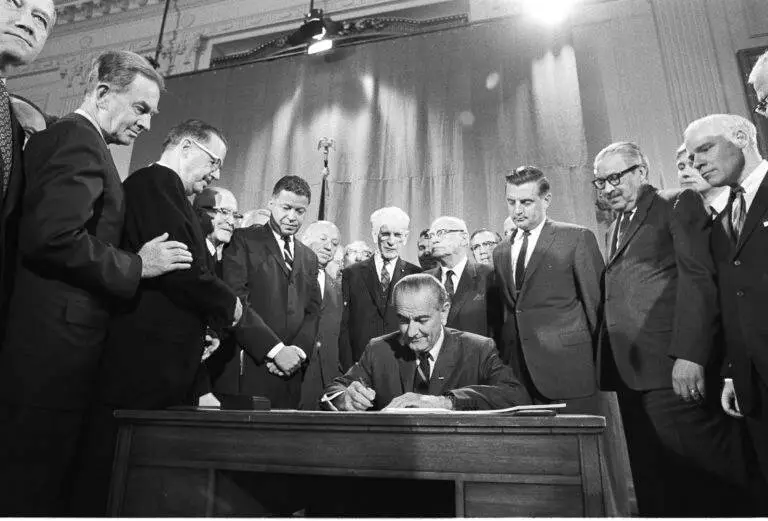
What We Have, What We’ve Lost, and What We Must Build. Civil Rights Act of 1968 (Fair Housing Act), Pub. L. No. 90-284, 82 Stat. 73 (1968). Signed by President Lyndon B. Johnson on April 11, 1968, seven days after the assassination of Dr. Martin Luther King Jr. The bill had been stalled in Congress for two years. Its passage followed the urban uprisings of 1967 and 1968 in Newark, Detroit, and more than 100 other American cities. The Senate passed the bill on April 10, 1968. The House passed it on April 11. Johnson signed it the same day. National Fair Housing Alliance, 2024 Fair Housing Trends Report, Washington D.C.: NFHA, 2024. Between 1968 and 2024, the Fair Housing Act has produced more than 200,000 documented fair housing complaints, generated billions of dollars in settlements and damages, and been used to challenge and dismantle explicitly discriminatory practices in lending, real estate, rental, insurance, and zoning. The explicit forms of discrimination that were commonplace in 1968 — posted signs, written restrictive covenants, openly stated refusals — have been substantially eliminated from legal practice. U.S. Census Bureau, “Quarterly Residential Vacancies and Homeownership,” Q4 2024. Black homeownership rate: 44.7 percent. White homeownership rate: 73.8 percent. Gap: 29.1 percentage points. At the time of the Fair Housing Act’s passage in 1968, the Black homeownership rate was approximately 41.9 percent and the white rate was approximately 65.9 percent, producing a gap of approximately 24 percentage points. The gap has widened by approximately 5 percentage points in 58 years. Executive Order No. 14281: Restoring Equality of Opportunity and Meritocracy, April 23, 2025; HUD proposed rule eliminating disparate impact regulation, January 2026; HUD staff reductions of approximately 50 percent, February–March 2025. The current administration’s actions represent the most comprehensive rollback of fair housing enforcement infrastructure since the Act’s passage. Wilkerson, Isabel. The Warmth of Other Suns: The Epic Story of America’s Great Migration (New York: Random House, 2010). Between 1915 and 1970, approximately six million Black Americans migrated from the South to Northern and Western cities, building communities, businesses, and institutions under conditions of legal segregation, economic exclusion, and systematic violence. The accumulation of wealth, culture, and community infrastructure under those conditions represents the historical precedent for what determination without government protection can accomplish. Frazier, Eric Lawrence, MBA. The Power Is Now Media 2026 Fair Housing and Homeownership Series, Essays 1–10. Riverside, CA: The Power Is Now Media, 2026. This series represents the sixth consecutive year of fair housing programming produced by The Power Is Now Media, reaching homebuyers, housing professionals, real estate practitioners, and policymakers across the country through television, podcast, streaming platforms, and digital publication.
Fair Housing Series Part 9: The First-Generation Homebuyer

What Nobody Told You. Build It on a Rock. Federal Reserve Bank of New York, Center for Microeconomic Data: Household Debt and Credit Report Q4 2024, February 2025. Total household debt in the United States reached $17.94 trillion in Q4 2024. Student loan debt stands at $1.61 trillion. Credit card balances stand at $1.17 trillion, the highest recorded level. Auto loan debt stands at $1.66 trillion. American Bankruptcy Institute, 2024 Annual Business and Consumer Bankruptcy Filing Statistics, January 2025. Total bankruptcy filings increased 16.2 percent in 2024 compared to 2023, with consumer filings rising to 517,858 — the highest level since 2020. Chapter 7 liquidations represented 67 percent of all consumer filings. Consumer Financial Protection Bureau, Consumer Credit Trends: Mortgage Delinquencies and Defaults, Q3 2025. Mortgage delinquency rates among first-time buyers increased 18 percent between 2022 and 2025, with the primary contributing factors identified as insufficient cash reserves at closing, inability to absorb unexpected home maintenance costs, and debt-to-income ratios at or near qualifying maximums. National Association of Realtors, Profile of Home Buyers and Sellers 2024, November 2024. Forty-three percent of first-time buyers report that the primary barrier to earlier homeownership was inadequate savings for down payment and closing costs. Among buyers who purchased with less than 5 percent down, 34 percent reported financial stress within the first two years of ownership attributable to insufficient reserves. National Financial Educators Council, Financial Literacy Survey 2024. The survey found that financial illiteracy cost the average American $1,819 in 2023. Among adults aged 18–24, 78 percent reported receiving no formal financial education from either school or family. The intergenerational transmission of financial illiteracy is documented: adults who grew up in households without financial conversations are three times more likely to carry high-interest consumer debt. Urban Institute, The Opportunity Costs of Financial Illiteracy Among Black and Hispanic Households, 2023. The study documents that Black and Hispanic households are disproportionately affected by financial illiteracy because they are less likely to have inherited financial knowledge from prior generations of homeowners and investors. The first-generation homebuyer in these communities faces not only the standard barriers to entry but also the absence of the informal advisory network that transfers financial knowledge within families that have owned property across generations. Matthew 7:24–27 (NIV). “Therefore everyone who hears these words of mine and puts them into practice is like a wise man who built his house on the rock. The rain came down, the streams rose, and the winds blew and beat against that house; yet it did not fall, because it had its foundation on the rock. But everyone who hears these words of mine and does not put them into practice is like a foolish man who built his house on sand.”
Fair Housing Series Part 8: The Fair Housing Act and the LGBTQ+ Community. – Footnotes

This Is America. The Melting Pot Belongs to Everyone. Pew Research Center, “American Views on Same-Sex Marriage,” November 2023. Support for same-sex marriage among Americans aged 18-29 stands at 79 percent, compared to 61 percent overall — a generational shift that represents the most rapid change in public opinion on any social issue in the modern polling era. U.S. Department of Housing and Urban Development, “HUD’s Equal Access Rule,” 77 Fed. Reg. 5662 (February 3, 2012); rescinded in part, February 2025. The Obama-era Equal Access Rule required HUD-funded programs to provide equal access regardless of sexual orientation or gender identity. The Trump administration halted enforcement of the Equal Access Rule on February 10, 2025. Movement Advancement Project, “Fair Housing Laws and Sexual Orientation and Gender Identity,” April 2026. As of 2026, twenty-seven states have no explicit state-level fair housing protections for LGBTQ+ individuals. In those states, absent federal protection, a landlord or seller may legally refuse to transact with a person on the basis of sexual orientation or gender identity. Bostock v. Clayton County, 590 U.S. 644 (2020). The Supreme Court held 6-3 that Title VII of the Civil Rights Act of 1964 prohibits employment discrimination based on sexual orientation and gender identity, reasoning that discrimination against a person for being gay or transgender necessarily involves discrimination based on sex. The ruling does not directly apply to housing, but fair housing advocates have argued that its logic extends to the Fair Housing Act’s sex discrimination prohibition. Executive Order No. 14168: Defending Women from Gender Ideology Extremism and Restoring Biological Truth to the Federal Government, January 20, 2025. The order directs federal agencies to recognize only two sexes for purposes of federal law and policy, and has been used as the basis for withdrawing federal fair housing and equal access protections that had been extended to transgender individuals. National Fair Housing Alliance, 2024 Fair Housing Trends Report, Washington D.C.: NFHA, 2024. The report documents a 25 percent increase in fair housing complaints citing sexual orientation and gender identity discrimination between 2018 and 2023, concentrated in states without explicit state-level protections.
Fair Housing Series Part 7: Gentrification: Displacement or Opportunity? – Footnotes

Hwang, Jackelyn, and Robert J. Sampson. “Reassessing Trends in Black Population Loss from American Cities, 1970–2009.” Du Bois Review 11, no. 1 (2014): 137–167. The study documents systematic displacement of Black residents from urban cores across major American metropolitan areas over four decades, driven by rising property values and rent increases following investment in previously disinvested neighborhoods. Rothstein, Richard. The Color of Law (New York: Liveright Publishing, 2017), 182–198. The neighborhoods that are gentrifying today are, in most cases, the same neighborhoods that were explicitly redlined by the FHA in the 1930s and 1940s. Their current desirability does not erase the history of their devaluation. The residents who were pushed into those neighborhoods by discriminatory policy are now being pushed out by the market forces that discriminatory policy made inevitable. National Community Reinvestment Coalition, Shifting Neighborhoods: Gentrification and Cultural Displacement in American Cities, March 2019. The report identifies 1,049 census tracts that gentrified between 2000 and 2013, with Black and Hispanic residents bearing the largest share of displacement in cities including Washington D.C., New York, Los Angeles, and Chicago. Hertz, Daniel. “The Connection Between Affordable Housing and Jobs.” Center for Neighborhood Technology, 2015. Workers displaced from urban cores to outlying areas spend a disproportionate share of income on transportation, with low-income households in car-dependent outer suburbs spending up to 25 percent of household income on commuting costs — effectively negating any savings from lower housing costs. Stehlin, John. “The Post-Industrial “Shop Floor”: Emerging Forms of Gentrification in San Francisco’s Innovation Economy.” Antipode 48, no. 2 (2016): 474–493. The study documents the relationship between the tech economy’s colonization of urban space and the displacement of service workers who supported that economy but can no longer afford to live near it. Zuk, Miriam, et al. “Gentrification, Displacement and the Role of Public Investment.” Federal Reserve Bank of San Francisco Community Development Working Paper 2015-05. The study finds that while gentrification produces measurable neighborhood improvements in physical infrastructure, school quality, and retail access, long-term lower-income residents rarely benefit because they are displaced before those improvements materialize in their household finances. Joint Center for Housing Studies of Harvard University, The State of the Nation’s Housing 2025, June 2025. The report documents that the price-to-income ratio for entry-level homeownership has reached historic highs in every major metropolitan market, with the most severe conditions in coastal cities where gentrification has been most pronounced. Multi-family purchasing and co-investment structures have emerged as the primary access mechanism for moderate-income households. National Association of Realtors Research Group, Profile of Home Buyers and Sellers 2024, November 2024. The median down payment among first-time buyers rose to 9 percent in 2024, with 38 percent of first-time buyers citing “preference for a different area” as the primary reason for not purchasing sooner — a figure that has remained consistent for over a decade and suggests that location preference, not price alone, is the dominant barrier to entry for this segment.
Fair Housing Series Part 6: The Racial Wealth Gap and the House That Built It. – Footnotes

And the House That Should Have Been Yours. National Association of Realtors Research Group, Snapshot of Race and Home Buying in America, February 2022. The report documents that the typical homeowner had a net worth of $300,000 compared to $8,000 for the typical renter — a ratio of 37.5 to 1. Among racial groups, the wealth accumulation differential tracks almost exactly with the homeownership rate differential. Bhutta, Neil, Andrew C. Chang, Lisa J. Dettling, and Joanne W. Hsu. “Disparities in Wealth by Race and Ethnicity in the 2019 Survey of Consumer Finances.” Federal Reserve FEDS Notes, September 28, 2020. The median white family held wealth approximately 7.8 times greater than the median Black family. The Federal Reserve’s analysis of the National Association of Realtors data on homeowner versus renter wealth shows the homeowner net worth advantage at approximately 40 times that of renters. Rothstein, Richard. The Color of Law (New York: Liveright Publishing, 2017), 59–75. FHA underwriting manuals from 1936 through the late 1940s explicitly refused to insure mortgages in racially mixed or predominantly Black neighborhoods. The agency’s Underwriting Manual stated that “incompatible racial groups should not be permitted to use the same community.” Katznelson, Ira. When Affirmative Action Was White (New York: W.W. Norton, 2005), 113–141. Of the 3,229 VA-guaranteed home loans in Mississippi in 1947, fewer than 2 were made to Black veterans. In New York and northern New Jersey, fewer than 100 of the 67,000 mortgages insured by the GI Bill went to non-white borrowers. Realtor.com, 2026 Housing Supply Gap Report, March 3, 2026. The national housing supply deficit stands at 4.03 million units. In high-cost metropolitan markets, the median home price to median household income ratio for Black families now exceeds 7 to 1, making single-household purchase without substantial down payment assistance or family pooling effectively impossible in most major markets. Perry, Andre M., Jonathan Rothwell, and David Harshbarger. “The Devaluation of Assets in Black Neighborhoods.” Brookings Institution, November 27, 2018. Homes in Black-majority neighborhoods are undervalued by an average of $48,000 per home, totaling approximately $156 billion in lost equity across the country — a direct consequence of decades of discriminatory appraisal practices that persist in modified form today. Pew Research Center, “The Return of the Multi-Generational Family Household,” March 18, 2010; updated analysis, 2023. Multi-generational household formation among Black Americans increased 25 percent between 2010 and 2023, driven by housing cost burdens, student debt, and the strategic recognition that pooled household resources produce better wealth outcomes than single-family household formation.
Fair Housing Series Part 5: Digital Redlining – Footnotes

Algorithmic Bias and the New Face of Housing Discrimination. Fannie Mae, Desktop Underwriter Version 11.0 Release Notes (2022). Automated underwriting systems are trained on historical loan performance data. Because historical lending patterns reflect decades of discriminatory underwriting, the training data itself embeds the outcomes of prior discrimination. The system learns which borrower profiles historically produced defaults — profiles shaped in part by exclusion from refinancing, from prime products, and from wealth-building opportunities. U.S. Census Bureau, “Quarterly Residential Vacancies and Homeownership,” Q4 2024. The Black homeownership rate of 44.7 percent and white homeownership rate of 73.8 percent produce a racial gap of 29.1 percentage points — wider than the gap recorded in 1968 at the time of the Fair Housing Act’s passage. National Fair Housing Alliance v. Facebook, Inc., No. 1:18-cv-02689 (S.D.N.Y. 2018). The complaint documented that Facebook’s ad delivery algorithm steered housing advertisements away from users based on race, national origin, religion, sex, familial status, and disability — protected classes under the Fair Housing Act — without any explicit targeting instruction from advertisers. U.S. Department of Housing and Urban Development, Conciliation Agreement between HUD and Meta Platforms, Inc., June 21, 2022. Meta agreed to overhaul its ad delivery system for housing, employment, and credit categories and to submit to regular audits. The settlement resolved HUD’s charge that Facebook’s use of its Special Ad Audience tool violated the Fair Housing Act by using algorithmic proxies for protected characteristics to limit ad distribution. Faber, Jacob W. “Fortifying the Walls: How Digital Advertising Platforms Facilitate Housing Segregation.” Housing Policy Debate 33, no. 1 (2023): 1–21. The study documents how digital platforms’ use of lookalike audiences and behavioral targeting in housing advertising produces geographic and demographic segregation in who receives homeownership information — independent of any explicit discriminatory intent by advertisers. Bartlett, Robert, Adair Morse, Richard Stanton, and Nancy Wallace. “Consumer-Lending Discrimination in the FinTech Era.” Journal of Financial Economics 143, no. 1 (January 2022): 30–56. The study analyzed 9 million mortgage records and found that FinTech lenders charged Black and Hispanic borrowers approximately 8 basis points more than similarly qualified white borrowers, generating approximately $765 million in excess interest payments annually. National Fair Housing Alliance, 2023 Fair Housing Trends Report (Washington, D.C.: NFHA, 2023). The report documents the systematic testing methodology used to identify algorithmic discrimination in online housing platforms and advertising networks, and catalogs the enforcement actions and settlements that have resulted from that testing.