By Eric Lawrence Frazier, MBA
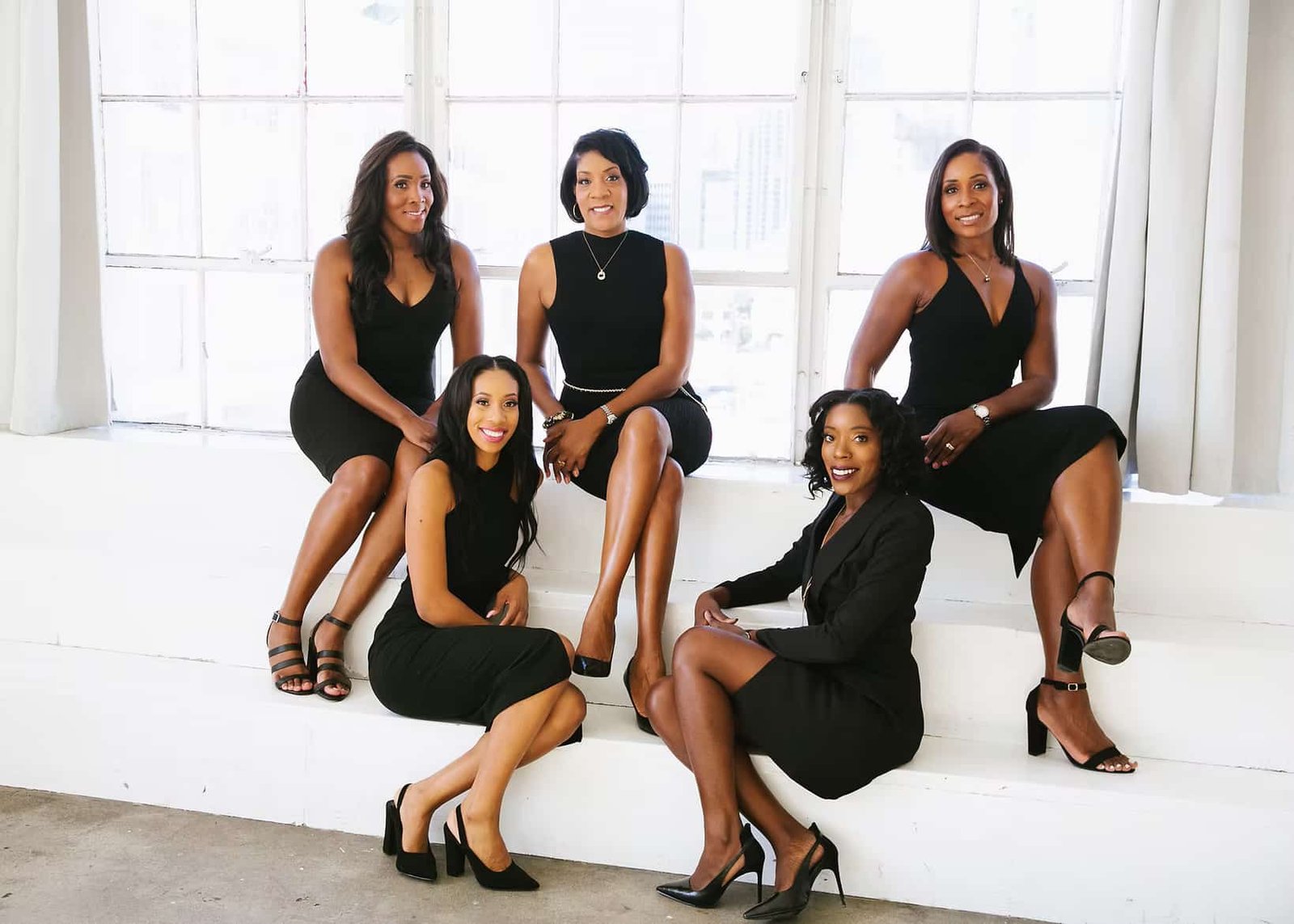
The picture in the header of this article is one of many group pictures I have of my wife and daughters. You can see more of them on the website of FrazierGroupRealty.com.
They look like women who have stepped off the cover of Ebony magazine. They are Nubian queens — absolutely beautiful, gorgeous, and among the most intelligent people God has ever made. Of course, I am very biased. What can I say? I am Ruby’s husband and their father. I love them, and I have loved them their entire lives. I have loved my wife since the day we met, forty-six years ago, and I have been married to her for forty-four of those years.
Look at the picture. It is also on the cover of this issue of Faith, Family, and Finance Magazine. Each of them accomplished, each of them grounded, each of them carrying themselves with the particular kind of quiet confidence that does not need to announce itself. When I look at that image, I do not see a lucky man. I see the product of a decision made forty-four years ago by a young woman who understood, even then, that the work of building a family is the most serious work a human being can take on.
I married Ruby Lee Frazier on December 19, 1981. I was nineteen years old. She was young, too, and we had no particular roadmap for what we were stepping into. What we had was each other, a shared seriousness about life, and the unspoken agreement that we were going to build something real. I have spent forty-four years now on the other side of that agreement, and I can say without qualification: everything I have built, every credential I have earned, every platform I have created — none of it happens without her. Not a page of it.
This article is not a celebration of me. It is a reckoning with what women actually do — what they carry, what they build, what they sacrifice, and what they produce. My wife and our daughters are not abstractions. They are the specific evidence I am drawing from. But the argument extends far beyond our household. Women are reshaping the economic, professional, and social landscape of this country in ways that the traditional narrative has consistently underestimated. The data is no longer subtle. The women are no longer waiting for permission.
The Architect of the House
Ruby Frazier did not stumble into leadership. She grew into it deliberately, the way a tree grows into the shape the light demands of it. When our daughters were young, she made a choice that is difficult to fully communicate in this era of individual metrics and personal career timelines — she chose to be present. Not because she lacked ambition. Anyone who knows Ruby understands that ambition is among her most defining qualities. She chose presence because she understood what was actually at stake. She was raising human beings, not just children, and she intended to do it with the same precision and intentionality that she brought to everything else.
The results speak for themselves, but the results alone do not tell the story. What our daughters’ titles and degrees do not capture is the environment that produced them — the household where expectations were clear, where education was non-negotiable, where faith was lived rather than performed, where a woman managed the complexity of family life with the skill of a seasoned executive long before she became one.
By the grace of God, I was able to provide financially in a way that gave Ruby the latitude to focus on the family. The arrangement was not a diminishment of her. It was a strategic deployment of her. We understood, even before we had the language for it, that the single most impactful investment we could make was in the full attention of a brilliant woman applied to the development of our children. The return on that investment is standing in that photograph.
But Ruby did not stop there. Alongside raising four daughters, she built. She ran businesses from the earliest years of our marriage — a candle and incense business in the beginning, then into mortgage and real estate operations alongside me as we built our companies. In 2006, she founded Frazier Group Realty, Inc., where she serves as President and CEO, leading a full-service real estate firm covering residential and commercial properties across the Inland Empire, Orange County, and Los Angeles. She holds the NAR GREEN designation and the BPOR designation. She has served as a Board Member of the UC Riverside Foundation Board of Trustees for seven years. She is a Charter Member of the Riverside Downtown Lions Club, an Interior Design Consultant, a Notary Public, and co-founder of Copper Goat Coffee in Riverside — a brick-and-mortar business that represents her entrepreneurial range beyond real estate. She served as First Lady of our church during my years as senior pastor. She is sought after for her counsel and wisdom by people who have known her for decades and people who have just met her.
She did all of this while being the center of our family. That is not a small thing. That is, in fact, the thing.
The Daughters
Jessica Frazier is the oldest, and she is perhaps the clearest expression of what her mother’s investment produced. She is currently the Principal Staff Analyst for Real Property at the Orange County Sanitation District, where she serves as the agency’s expert in all matters of real property — acquisitions, dispositions, appraisals, right-of-way, easements, contracts, and title. It is complex, high-stakes public sector work, the kind that requires both legal fluency and the ability to negotiate on behalf of institutions that serve millions of people. Simultaneously, she has served as a Real Estate Instructor at UCLA Extension since 2015, for nearly a decade, teaching, curriculum development, and professional formation of the next generation of real estate practitioners. She holds an MBA in Management from the University of Redlands and a Bachelor of Arts in Sociology from UC Riverside. She is also a licensed real estate professional and a certified travel advisor. Jessica operates at multiple registers simultaneously — institutional, academic, and entrepreneurial — without appearing to strain under any of them.
Briana Frazier Cannon is the second daughter, and her profile is the most deliberately diverse of the four. She is a Real Estate Broker Frazier Group Realty, Inc. — a company she has been a part of since April 2005, meaning she has now been operating in the real estate industry for twenty years. She currently teaches Real Estate Principles and Practices as an Adjunct Faculty Instructor at El Camino College, and also serves as an Adult Education Teacher with the Norwalk-La Mirada Unified School District, where she prepares students for California DRE licensure. Before her pivot toward education and brokerage, she ran Events by Bree for over eleven years — a full-service event management company she built and operated out of Whittier. She holds an MBA and a Bachelor of Arts in Political Science, both from Chapman University’s George L. Argyros School of Business and Economics. Briana is also a mother, which is the role she would likely tell you is the most demanding of the several she carries. She is, in that respect, her mother’s daughter.
Erica Frazier Twumasi is the third daughter, and her career is a study in the compounding of expertise over time. She is the Senior Manager of Program Management for Construction at Nordstrom, where she leads the project management team responsible for Nordstrom Rack store construction nationally — overseeing strategic planning, financial management, cross-functional team leadership, contractor sourcing, permitting, entitlements, and executive-level reporting. She has managed construction projects with budgets ranging from five million to five hundred million dollars. Before Nordstrom, she was a Senior Construction Project Manager at Target for nearly four years. Before that, she spent nearly five years as a Project Manager at Harbor Freight Tools, where she won the 2014 Silver Hammer Award for Excellence and was named to a Top Leaders Under 40 list. As of August 2025, she joined the UCLA Extension faculty as an Instructor in Real Estate Development and Construction Management. She holds an MBA with an emphasis in International Business from the University of Redlands and a Bachelor of Arts in Literary Journalism from UC Irvine. She is also a licensed Realtor Associate with Frazier Group Realty. Erica is, in the clearest professional sense, a builder of stores, of programs, and now of the next generation of construction and real estate professionals.
Raela Frazier is the youngest, and as of February 2026 — this month, as this issue goes to press — she has just stepped into a new role as Sr. IC, Global Sourcing Manager for Apparel, Pet & Human at Petco. Before Petco, she spent two years as an Assistant Merchant at Torrid, managing end-to-end product development and sourcing for sweaters and outerwear. Before that, she was an Assistant Buyer at Burlington Stores, where she managed a sixty-million-dollar Missy’s Dresses business and a forty-eight-million-dollar personal care and beauty business. She has managed visual merchandising at Target and Forever 21, and completed a merchandising internship in London. She holds a Bachelor of Science in Apparel Merchandising and Management from Cal Poly Pomona. Raela moves through the retail industry with a precision that her mother would recognize — detail-oriented, results-driven, and unwilling to be defined by any single category.
What the Numbers Actually Say
The Frazier women are not exceptional in a vacuum. They are part of a broader movement that is rewriting the demographic reality of American professional and economic life. The data deserves to be engaged directly, because it is both encouraging and, in places, still sobering.
In real estate — an industry that our family has lived in for decades — women are not newcomers. They are the majority. Women now represent more than 56 percent of all real estate agents in the United States. Single women own roughly 10.9 million homes in America compared to 8.24 million owned by single men, a gap that has been growing consistently since at least 1981. As of 2024, single women made up 20 percent of all homebuyers nationally, while single men accounted for only 8 percent. In 47 of the 50 states, single women are more likely than single men to own a home. That is not a trend. That is a structural reality.
The homeownership story is particularly meaningful when read through the lens of Black women. According to the 2024 Snapshot of Race and Home Buying in America, single Black women accounted for 29 percent of all Black homebuyers — the highest rate of any single-buyer demographic within that community. They are buying despite persistent wage gaps, despite higher mortgage rates, and despite credit market conditions that are systematically harder for them to navigate. They default on their mortgages less frequently than men across every ethnic group. They are, in short, more financially disciplined than the systems that underserve them.
At the corporate level, women now lead 55 Fortune 500 companies — the first time that number has crossed the 11 percent mark in the ranking’s history. That is a 2,500 percent increase from 1998, when only two Fortune 500 companies had female CEOs. Among those women at the top, 45 percent hold MBAs. The 2024 SP 200 — the real estate industry’s power ranking — included 53 female leaders, more than ever before, and women represented 64 percent of that year’s Watchlist of rising leaders. In education, women now earn more than 60 percent of bachelor’s degrees in the United States. The pipeline is not the problem.
The honest account requires acknowledging where the gaps remain. Women still hold only 11 percent of Fortune 500 CEO positions. The pace of change at the C-suite level has been described by gender equity researchers as glacially slow. Women of color face compounded barriers — Black and Hispanic women own homes at rates 20 to 30 percentage points below those of white women. And women still pay more for mortgages than men in 49 of the 50 states, according to Home Mortgage Disclosure Act data.
The full picture, then, is one of accelerating advancement against still-real structural resistance. Women are not waiting for the resistance to dissolve. They are moving through it.
What Marriage Taught Me About Women
Over the last forty-four years, I have learned some important lessons about marriage and about women. I grew up in a traditional home where my father was the absolute law. All decisions ran through him. It was a genuinely patriarchal environment, and inside that environment I absorbed a template — I would be the leader, I would be the decision-maker, I would be running things. The marriage began that way. Much of it was reinforced by the theological framing I received in ministry and by watching my parents operate. But it wasn’t long after our first child arrived, and my absolute dependence on Ruby became undeniable, that I began to change.
What I came to understand is that marriage is not a hierarchy. It is a joint operation called life. The struggle for power and authority inside a marriage is, at its core, a waste of the only resource neither partner can recover — time. When you understand your role and who you are in a relationship, you are too busy trying to be the best you can be in that role to spend energy trying to control how the other person executes theirs. You also begin to recognize their individuality, their God-given talent and abilities — the specific things they carry that you do not have and cannot replicate.
I am grateful we married at nineteen. Getting married at thirty, forty, or fifty — after years of building a fully independent self, after the raw core of individualism and the desire to control one’s own destiny has calcified — I am not sure that same melting into partnership would have been possible. What Ruby and I arrived at over time is something closer to what happens between two nations that both possess the capacity for serious damage: they stop trying to annihilate each other and start respecting what each brings to the table. Not a surrender of identity — an acknowledgment of equal weight.
Men have a long tradition of speaking about their own accomplishments and then, almost as an afterthought, crediting their wives — ultimately patronizing in a way that reduces the woman to a supporting function. I have done that. I am not proud of it. That is not what this is. I am not praising Ruby for what she did for me. I am observing, as clearly as I can, what she did in total — as a professional, as a leader, as a builder, as a mother, as a person — and I am naming it with the precision and honor it deserves.
The Tradition and the Moment
Women’s History Month exists because history has a habit of omitting women’s contributions until someone insists on recording them. It is not a sentiment. It is a corrective — an annual attempt to rebalance a historical ledger that has been systematically kept wrong.
The women I have described in this article — my wife, my four daughters — are not historical footnotes. They are present-tense realities. Ruby Frazier is still building. Frazier Group Realty serves clients across three counties. Copper Goat Coffee is open in Riverside. Her counsel is still being sought. Jessica is managing real property for a public agency that serves millions. Briana is teaching the next generation of real estate professionals. Erica is building stores and teaching construction management at UCLA. Raela just walked into her next chapter this month.
The tradition of strong women in Black American families is older than any institution that has tried to define or limit it. It runs through churches, through credit unions, through school board rooms and kitchen tables, through property deeds signed in the face of every system designed to prevent the signing. Ruby Frazier and the daughters she raised are part of that tradition — not as symbols, but as practitioners.
When I look at that photograph, what I see is evidence of what deliberate partnership produces, of what intentional motherhood builds, and of what women accomplish when the structures around them give them room to move. The Frazier women have moved. They are still moving.
That is the story I wanted to tell. It is also the story happening in front of anyone who is paying attention.
These reflections also take shape in a poem—you can read it here.
Thank you for taking the time to read and reflect. I write to help people think clearly about money, business, real estate, and life — not from theory, but from decades of lived experience.
If you are navigating a financial decision, building a business, considering homeownership, or simply trying to make better use of your time and resources, I invite you to engage further.
Visit EricFrazier.com to learn more about my advisory services, schedule a consultation, or explore additional writing and resources designed to help you lead with clarity and discipline.
Eric Lawrence Frazier, MBA
Your Trusted Advisor in Business and Wealth
thepowerisnow.com | ericfrazier.com
Real Estate Broker CA DRE 01143484 | Mortgage Originator NMLS 461807