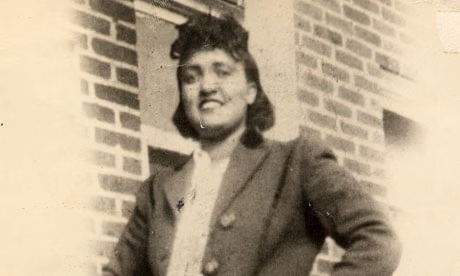
On February 5, 1951, Henrietta Lacks was on a table at Johns Hopkins Hospital in Baltimore, Maryland, receiving a radium treatment for cervical cancer. She was thirty years old. She was the mother of five children. She was the wife of David Lacks, who worked at the Bethlehem Steel mill at Sparrows Point. She was a woman who enjoyed dancing, cooking, playing cards, and taking her children to visit the tobacco fields of Clover, Virginia, where she had grown up. She was unconscious.
While she was unconscious, the resident surgeon Lawrence Wharton Jr. excised a biopsy of approximately one square centimeter from the edge of her cervical tumor. He also took a sample of healthy cervical tissue from nearby. Neither sample was medically necessary for her treatment. Neither was taken with her knowledge. Neither was taken with her consent. The only document Henrietta Lacks had signed at Johns Hopkins was titled “Operation Permit” — consent to anesthetic and surgical procedures deemed necessary for proper care. Harvesting tissue samples for research purposes was not what she had agreed to. She did not know it was happening. She would never know.
The samples were transferred to Dr. George Otto Gey, the head of tissue culture research at Johns Hopkins. Gey had been attempting for years to grow human cells in laboratory conditions long enough to study them. Every previous sample had died within days. His assistant Mary Kubicek received the tumor sample, covered it in culture medium, and labeled it “HeLa” — He for Henrietta, La for Lacks — according to the lab’s naming convention. Within forty-eight hours, Lacks’s cancer cells were growing. Within twenty-four hours after that, they had doubled. They continued to double every twenty to twenty-four hours. The healthy tissue sample died. The cancer cells did not stop.
Henrietta Lacks died on October 4, 1951. She was thirty-one years old. The cancer had spread throughout her body, unresponsive to the radiation that had been administered in the same procedure in which her cells were taken. She was buried in an unmarked grave on the tobacco farm in Clover, Virginia, where she had grown up — the same farm where her ancestors had been enslaved. Her cells were already dividing in George Gey’s laboratory. They have not stopped since.
Clover, Virginia, to Baltimore: The Life the World Has Mostly Not Bothered to Learn
Henrietta Lacks was born Loretta Pleasant on August 1, 1920, in Roanoke, Virginia, the ninth of ten children of Johnny and Eliza Pleasant. Her mother, Eliz, died in 1924, following the birth of her tenth child, when Henrietta was four years old. Her father moved the family to Clover, Virginia, dividing the children among relatives. Henrietta went to live with her grandfather, er Tommy Lacks, on the same tobacco farm where the family’s ancestors had worked as enslaved people. Her cousin David — known as Day — came to live there too. They grew up together on that farm. They married each other on April 10, 1941. Henrietta was twenty years old.
In the early 1940s, a cousin encouraged David to move north to Baltimore, where Bethlehem Steel’s Sparrows Point mill was hiring and paying wages that tobacco farming in Clover never could. They moved. David worked the mill. Henrietta managed the household in Turner Station, the tight Black community in the Dundalk neighborhood of Baltimore, where the mill workers and their families lived. They had five children: Lawrence, Elsie, David Jr. (known as Sonny), Deborah, and Zakariyya. She was known in the neighborhood as someone who kept her door open — housing extended family members making the transition to Baltimore, feeding people, filling the house. She danced. She cooked. She played cards. She took the children to Clover on weekends to stay connected to the land and the people they had come from.
Her daughter,r Els, i.e., was developmentally disabled and was placed in the Hospital for the Negro Insane — later renamed Crownsville Hospital Center — around the time Henrietta’s cancer was being diagnosed. Elsie died there in 1955 at fifteen. There is documentation suggesting that Elsie may have been subjected to pneumoencephalography, a procedure in which fluid is drained from the brain and replaced with air or gas to improve imaging — a painful and dangerous practice. The family did not know the details. They rarely did. That pattern of not knowing, of being excluded from information about what was being done to the people they loved by the medical institutions they could not afford not to trust, would define the Lacks family’s relationship with medicine for the next seven decades.
Johns Hopkins was the only major hospital in Baltimore that would treat Black patients in 1951. Segregation was the law. It was also practice. Patients in the public wards — which meant Black patients, poor patients, and patients who had nowhere else to go — routinely had their tissue samples collected for research without their knowledge. This was standard operating procedure. It was also, by any honest reckoning, a system in which the people least positioned to refuse bore the full cost of the research that benefited everyone else.
What Her Cells Built. The Scale of It Is Almost Impossible to State.
By 1952, HeLa cells were being mass-produced at a facility established at the Tuskegee Institute in Alabama — staffed largely by Black scientists and technicians, many of them women — to meet the national demand generated by the polio vaccine effort. Rebecca Skloot, whose decade of research produced the definitive account of this history, captured the historical irony with precision: Black scientists used cells from a Black woman to help save millions of lives — most of them white — on the same campus, at the very same time, that state officials were conducting the Tuskegee syphilis study. The juxtaposition is not incidental. It is the argument.
Jonas Salk used HeLa cells in 1954 to develop and test his polio vaccine. That vaccine ended one of the most feared diseases in American life. HeLa cells were the first human cells successfully cloned in 1955. They have since been used in the development of the COVID-19 vaccines; cancer research across virtually every type of malignancy; AIDS research; the mapping of the human genome; in vitro fertilization; cloning; gene therapy; and the study of viruses, radiation effects, toxic substances, and hundreds of pharmaceutical compounds. They have been used to test the safety of tape, glue, cosmetics, and consumer products. Approximately 11,000 patents involve HeLa cells. More than 100,000 scientific publications have been based on research using HeLa cells. At least 75,000 studies. An estimated 55 million or more individual cells are used.
What made her cells biologically extraordinary is now understood: they had upregulated telomerase — the enzyme that prevents the chromosome shortening that causes normal cells to stop dividing. They were also markedly aneuploid, carrying approximately 76 chromosomes rather than the normal 46. These properties made them genuinely immortal in laboratory conditions: capable of indefinite division, reproducible identically in any laboratory in the world, stable enough to run thousands of experiments on identical cellular material. Before HeLa, experiments on human cells were essentially impossible at scale. With HeLa, the modern era of human cell biology began.
The family did not know any of this for twenty-four years. When researchers began experiencing contamination problems in the global HeLa supply in 1975, they tracked down Henrietta’s husband, Davi,d and her children to take blood samples for comparison — again, without adequate informed consent, again with scientific justifications that the family was not equipped to evaluate and was not helped to understand. The family learned about HeLa from a 1976 Rolling Stone article. The journalist had gotten her name wrong. He called her Helen Lane. The family was confused about whether their wife and mother was somehow still alive, whether something had been done to keep her alive without telling them, whether the cells growing in laboratories around the world were, in some sense, Henrietta herself.
They were not entirely wrong to wonder.
What the Law Said. And What It Left Unresolved.
What was done to Henrietta Lacks was wrong. The law would later change to address practices like it. In 1951, however, what was done to her was legal. The collection of tissue from patients in public wards without their informed consent was standard practice in American medicine. The absence of federal regulations governing human subjects research would not be corrected until the National Research Act of 1974 and the Belmont Report framework that followed it — enacted in substantial part because of cases like hers, the Tuskegee Syphilis Study, and a catalogue of other experiments in which the people who bore the cost were poor, Black, institutionalized, or imprisoned.
The law that emerged did not resolve the commercial question. In 1990, the California Supreme Court ruled in Moore v. Regents of the University of California that patients do not retain property rights over cells removed from their bodies — even when those cells are used for commercial purposes without consent or compensation. That ruling is still the operative law. Henrietta Lacks’s cells have generated the biological foundation for a multimillion-dollar global industry in biological materials. The Lacks family, for most of that time, lived in poverty. They could not consistently afford health insurance. The irony is not subtle: a family whose matriarch’s cells helped develop vaccines, cancer treatments, and gene therapies could not always pay their own medical bills.
In 2013, German researchers published the full genome of a HeLa cell line without consulting the family. The genome contains hereditary information about not just Henrietta but every biological descendant of hers still living. The family’s response — and the public pressure that followed — produced an agreement with the National Institutes of Health: HeLa genome data would be stored in a controlled-access NIH database, two Lacks family members would join the committee regulating access, and researchers would be required to acknowledge the family in papers using the data. It was a meaningful step. Is also arrived at seventy-two years after the cells were taken.
In October 2021, the estate of Henrietta Lacks filed a federal lawsuit against Thermo Fisher Scientific — a Massachusetts-based science and technology company — alleging that it had been unjustly enriched by mass-producing and commercially distributing HeLa cells for profit. Thermo Fisher’s own website acknowledged the “unsanctioned use of HeLa cells from Henrietta Lacks.” The company sought dismissal on statute of limitations grounds. On August 1, 2023 — what would have been Henrietta Lacks’s 103rd birthday — the estate reached a confidential settlement with Thermo Fisher. The terms were not disclosed. Attorney Ben Crump, at the announcement: “This Black woman gave so much to the world, it’s good to give her a present back on her birthday.”
HeLa Is Henrietta. The Cells Cannot Be Separated From the Person.
The legal scholar Deleso Alford, who filed an amicus brief in support of the Lacks family’s lawsuit against Thermo Fisher, stated that the settlement “informs society that her unique cells cannot be disassociated from her being.” That sentence does the most important work in this entire history. The science community spent decades treating HeLa as a tool, a cell line, a biological instrument — deliberately separated from the person whose tumor produced it. Gey’s own naming convention, using only initials, was designed to protect anonymity. The anonymity it also protected was the anonymity of what had been done.
Ben Crump, the family’s lead attorney, put it with the clarity that the legal record required: “Not only were the HeLa cells derived from Henrietta Lacks — the HeLa cells are Henrietta Lacks.” That is not a metaphor. It is a statement about biological and moral continuity. The cells growing in a laboratory in Tokyo or London or Nairobi or São Paulo right now are the direct, unbroken lineage of the tumor biopsied from Henrietta Lacks’s cervix on February 5, 1951, without her knowledge or consent. Every experiment run on them carries, at its biological foundation, the cellular material of a Black woman from Clover, Virginia, who never knew she was donating anything.
Johns Hopkins Medicine, in its formal acknowledgment of the history, has stated: “Johns Hopkins could have — and should have — done more to inform and work with members of Henrietta Lacks’ family out of respect for them, their privacy and their personal interests.” That acknowledgment is accurate and insufficient in equal measure. The institution that took her cells without consent, that distributed them globally without compensation, that allowed her family to live for decades in ignorance of what had been done, has stated that it could have done more. Yes. It could have. The distance between what it did and what it could have done is the distance that bioethics, as a field, has spent seventy years trying to measure and close.
What her story forced medicine to confront is not simply the question of consent, though it forced that question with clarity. It forced the question of who bears the cost of scientific progress. In American medicine through the mid-twentieth century, that question had a consistent answer: the people who bore the cost were the people who had the least power to refuse. Black patients in segregated public wards. Prisoners. The institutionalized. The poor. The people whose cells, bodies, and lives were available to the research enterprise because the system that was supposed to protect them had decided that their protection was secondary to the knowledge that could be extracted from them. Henrietta Lacks’s story is the sharpest single illustration of that pattern because her cells turned out to be so extraordinarily valuable that the extraction could not be hidden indefinitely.
The Debt Is Scientific, Moral, and Unresolved. All Three at Once.
The world has been catching up to Henrietta Lacks, slowly and imperfectly, since 1976. The HeLa Women’s Health Conference at Morehouse School of Medicine, established in 1996 by physician Roland Pattillo, has met annually to recognize her contribution and the broader contribution of African Americans to medical research. Pattillo donated a headstone for her previously unmarked grave in 2010. Johns Hopkins established its annual Henrietta Lacks Memorial Lecture Series the same year. A statue of Henrietta Lacks by sculptor Helen Wilson-Roe stands in Bristol, England. A school in Virginia bears her name, opened in 2024. Morgan State University granted her a posthumous honorary degree. Senators introduced legislation to award her the Congressional Gold Medal. Her story, brought to mass attention by Rebecca Skloot’s 2010 book, was adapted into a film in 2017 with Oprah Winfrey portraying her daughter Deborah, who had spent decades trying to understand what had been done to her mother and who died in 2009, one year before the book was published.
None of it is commensurate. None of it can be. A woman died at thirty-one years old from a cancer she had little access to adequate treatment for, in a segregated hospital that was simultaneously using her body as a research instrument without her knowledge. Her cells became the foundation of modern human cell biology. Her family lived in poverty for decades while a global industry built itself on the biological material taken from her body. The acknowledgments and the honors and the settlements and the legislation are the world’s attempt to reckon with something that cannot be fully reckoned with, because the person at the center of it cannot be compensated. She has been dead since 1951. Her cells will outlive every person alive today.
What can be reckoned with — what her story demands be reckoned with — is the structure. The informed consent requirements that are now standard in medical research exist because of cases like hers. The Institutional Review Boards that govern human subjects research exist because of cases like hers. The regulations protecting patient privacy, the oversight of commercial use of biological material, the ongoing legal and ethical debate about who owns the genome — all of it was built, in significant part, on the foundation of what happened to a thirty-year-old Black woman in a Baltimore hospital in 1951 who never knew she was contributing anything at all.
She never knew. That is the fact that will not be resolved. Henrietta Lacks never knew that her cells were immortal. She never knew that they would be used to develop the polio vaccine. She never knew that Black women scientists at Tuskegee would grow her cells by the millions to save children she would never meet. She never knew that her tumor, biopsied while she lay unconscious, would be the foundation of more than 100,000 published scientific papers. She died in October 1951, thinking she was simply a woman with cancer who had run out of time. She was right about running out of time. She was wrong, in a way she never lived to understand, about the simple.
Thank you for taking the time to read and reflect. I write to help people think clearly about money, business, real estate, and life — not from theory, but from decades of lived experience.
If you are navigating a financial decision, building a business, considering homeownership, or simply trying to make better use of your time and resources, I invite you to engage further.
Subscribe to The Power Is Now TV to connect with me live every weekday, Monday through Friday, from 10:00 AM to 11:00 AM PST, as we record television shows across the Power Is Now TV Network. As a subscriber, you can participate in live tapings, engage in real-time discussions, and connect directly with industry leaders.
Visit ThePowerIsNow.com to access real estate magazines, books, podcasts, television shows, and exclusive media content focused on homeownership, business, and wealth-building.
For personalized support, consulting, and advisory services in real estate, mortgages, business, and personal finance, visit EricFrazier.com to schedule a consultation and learn more about my work as your trusted advisor in business and wealth.
Eric Lawrence Frazier, MBA
Your trusted advisor in business and wealth
www.ericfrazier.com | www.thepowerisnow.com
NMLS #451807 | CA DRE #01143484
Schedule a consultation: https://calendly.com/ericfrazier/real-estate-mortgage-consultation-clients