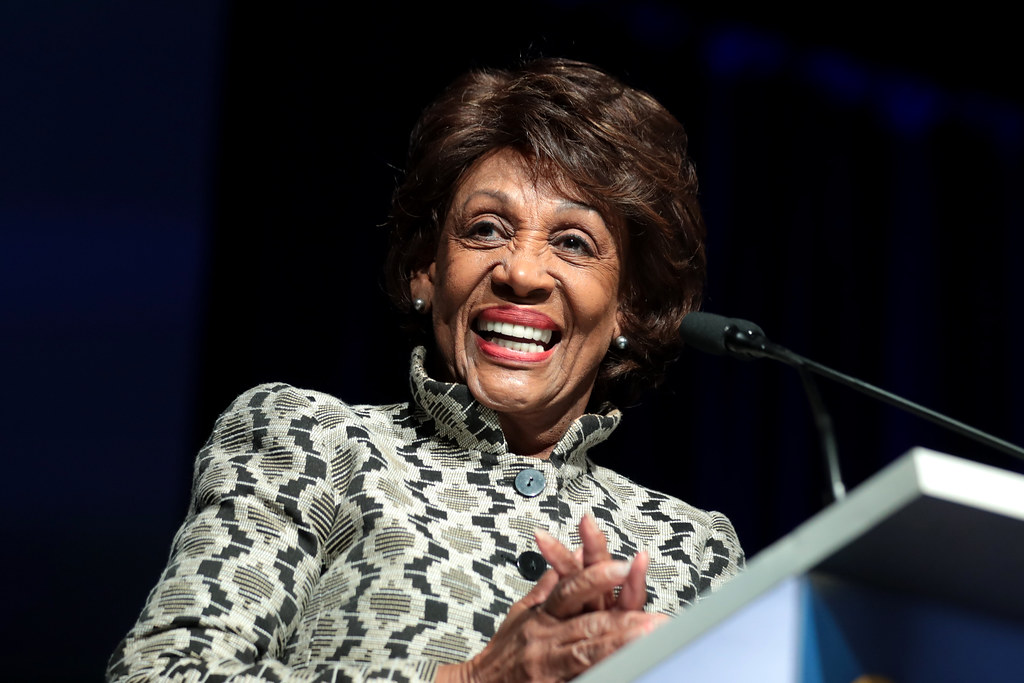
In July 2017, Maxine Waters sat at the dais of the House Financial Services Committee and asked Treasury Secretary Steven Mnuchin a question. Mnuchin began his response with an extended preamble about what an honor it was to be there, how much he appreciated the committee’s time, how he looked forward to a productive conversation. Waters listened for a moment. Then she interrupted. “Reclaiming my time,” she said. Under congressional procedure, a member who has yielded the floor is entitled to reclaim it if the respondent is consuming her allocated minutes without answering the question. Mnuchin attempted to continue. “Reclaiming my time,” she said again. And again. Each time, precise and unhurried, as though the phrase cost her nothing and the alternative — letting a powerful man use her time to avoid answering her question — was simply not available.
The phrase became a cultural phenomenon almost immediately. It was set to music. It was printed on T-shirts. It circulated across social media as a statement of self-possession that people recognized from their own lives: the meeting where someone else’s digression consumed the time you had been allocated to speak; the conversation where a powerful person answered a different question than the one you asked; the professional environment where your authority was treated as provisional, subject to revision by anyone with the confidence to test it. “Reclaiming my time” named the refusal to accept any of that. It named it precisely, procedurally, without rage or performance. Just: no. This is mine. I am taking it back.
The reason the phrase landed so hard is that it was not new. Maxine Waters had been saying it in that precise register — calm, certain, immovable — for her entire professional life. She began saying it in the garment factories and segregated restaurants of St. Louis, where she started working at thirteen years old. She was saying it in Watts when she organized Head Start parents to demand federal budget allocations from legislators who had not planned to hear from them. She was saying it in the California State Assembly when she moved the largest divestment of state pension funds from apartheid South Africa that any American state had ever executed. She was saying it from the floor of the House of Representatives across eighteen terms and counting. The Mnuchin hearing was just the first time a camera caught it in a frame the internet could transmit in a single clip.
The Fifth of Thirteen: What Poverty in St. Louis Actually Teaches
Maxine Moore Carr was born on August 15, 1938, in St. Louis, Missouri, the fifth of thirteen children of Remus Carr and Velma Lee Moore Carr. Her father left the family when she was two years old. Her mother raised thirteen children on a combination of low-paying intermittent work and public assistance. Waters has described her mother in terms that do not romanticize the difficulty: a strong woman, a survivor, whose determination served as an example. What poverty in a large family with an absent father actually teaches, in Waters’s account, is competition and voice. “Just getting heard in a family that size is difficult,” she has said. The skill of making yourself heard when no one has arranged the room for you to be heard in is the foundational political skill. She learned it before she had words for it.
She began working at thirteen in factories and segregated restaurants. She graduated from Vashon High School in 1956 and moved with her family to Los Angeles in 1961. There she worked in a garment factory and as a telephone operator while she figured out what came next. What came next was Head Start. In 1966, she was hired as an assistant teacher with the newly formed federal program in Watts — the same Watts neighborhood that had erupted the previous summer in one of the most significant urban uprisings in American history. Head Start was not simply a job. It was a theory of power: that what poor communities needed was not charity delivered from above but the organizational infrastructure to demand what they were owed. Waters became the voice for frustrated Head Start parents, organizing them to make federal budget requests, contact legislators, and lobby for program components tailored to their community. She has said of that period: “Head Start made a significant difference in my life. It helped me see how I could help people, and it helped steer me into politics.”
While working at Head Start, she enrolled at California State University, Los Angeles, and earned a bachelor’s degree in sociology in 1970. By graduation she was divorced and raising her two children alone. In 1973, she went to work as chief deputy to Los Angeles City Councilman David S. Cunningham Jr. — her first direct experience of the levers of municipal power. Three years later, she ran for the California State Assembly. She won. The trajectory from a St. Louis factory at thirteen to the California legislature at thirty-seven is not a story about luck or individual exceptionalism. It is a story about someone who identified the mechanisms of power, learned them from the inside, and used them with increasing precision for the next fifty years.
Sacramento: Where She Built the Foundation No One Remembers
Maxine Waters served seven two-year terms in the California State Assembly — fourteen years in Sacramento — before going to Congress in 1991. She rose to the position of Democratic Caucus Chair, one of the most senior positions in the California legislative caucus. The record she compiled in those fourteen years is the part of her career that has been most thoroughly overshadowed by her congressional tenure and by the cultural prominence she achieved in the Trump era. It should not be. What she built in Sacramento was the evidentiary base for everything she has argued about power and economic justice since.
She led the largest divestment of state pension funds from companies doing business with apartheid South Africa that any American state had ever executed. This was not a symbolic gesture. California’s pension funds are among the largest pools of institutional capital in the country; denying those funds to firms operating in South Africa imposed genuine economic pressure on the apartheid government and on the multinational corporations that sustained it. Waters did not do this as a foreign policy advocate from a safe distance. She had joined with and actively supported the African National Congress. She knew Nelson Mandela. She knew Desmond Tutu. The legislation she wrote reflected a person who understood that institutional capital, deployed with moral conviction, was one of the most powerful instruments available to a legislator who wanted to change something real in the world.
The rest of the California Assembly record: landmark affirmative action legislation; the nation’s first statewide Child Abuse Prevention Training Program; the prohibition of police strip searches for nonviolent misdemeanors; the nation’s first plant closure law. Each of these was a structural intervention in a system that was doing harm by design or by indifference. The strip search prohibition was about dignity and the specific indignity of a system that treated minor offenses by poor people as occasions for humiliation. The plant closure law was about the economic violence done to communities when employers left without notice or accountability. These were not feel-good measures. They were attempts to use the legislative power of the state to constrain what the powerful were permitted to do to the vulnerable.
She was also, during this period, the Los Angeles Chair of the Free South Africa Movement, one of the most consequential American grassroots campaigns of the late twentieth century. She had been a Democratic National Committee member since 1980. She was a key leader in five presidential campaigns. By the time she ran for Congress in 1990, upon the retirement of Representative Augustus F. Hawkins, she was not a newcomer to power. She was someone who had been operating at the intersection of legislative, economic, and grassroots power for nearly two decades. She won that first congressional race with over 79 percent of the vote.
Congress: The Legislation She Built Inside the System She Refused to Flatter
There is a version of Maxine Waters that the media has found easiest to cover: the confrontational one. The woman who called members of the Trump cabinet “crooked,” who led the chant of “no justice, no peace” in the streets of Los Angeles in 1992, who was willing to use language that made her colleagues uncomfortable and her opponents furious. That version is real. It is also incomplete in a way that serves the interests of the people she has been confronting for fifty years, because it allows her legislative record to be dismissed as the byproduct of a personality rather than taken seriously as a body of consequential work.
The Minority AIDS Initiative is one of the most significant public health programs in the history of the Congressional Black Caucus. Waters spearheaded its development in 1998 specifically to address the alarming spread of HIV/AIDS among African Americans, Hispanics, and other minorities — communities that were disproportionately affected by the epidemic and disproportionately underserved by the federal response to it. The initial appropriation was $156 million in fiscal year 1999. Under her continuing leadership over the decades that followed, annual funding grew to approximately $400 million. That is not an advocacy position. That is a federal funding stream that has sustained HIV/AIDS prevention, treatment, and research in communities of color for more than twenty-five years.
The Neighborhood Stabilization Program, which she authored, provides grants to states, local governments, and nonprofits to fight foreclosures, home abandonment, and neighborhood blight. She secured $6 billion for the program through two separate funding infusions. This is a program I understand from the inside. Thirty-five years in mortgage banking. I watched the foreclosure crisis unfold community by community in 2008 and after. The neighborhoods that were most devastated were the ones that had been most aggressively targeted by predatory subprime lenders in the years before — the same communities of color that received the least access to mainstream prime credit and the most aggressive sales of toxic financial products. The Neighborhood Stabilization Program was a direct legislative attempt to repair what the financial industry’s predatory practices had destroyed. Waters did not invent it from theory. She built it from the wreckage she could see from her district.
Section 342 of the Dodd-Frank Wall Street Reform and Consumer Protection Act of 2010 is Maxine Waters’s most structurally significant legislative contribution to American financial regulation. She authored this provision, which requires the creation of Offices of Minority and Women Inclusion at all twenty federal financial regulatory agencies — the Federal Reserve, the FDIC, the OCC, the SEC, the CFPB, and every other major regulatory body governing the American financial system. These offices are responsible for overseeing all matters relating to diversity in management, employment, and business activities at both the agencies themselves and at the financial institutions they regulate. It is, in the plain language of what it does: a requirement that the institutions monitoring the financial system look like the country the financial system is supposed to serve.
An economist at Howard University explained the logic to Congress in 2016 with a precision that deserves to be quoted: if the Federal Reserve had noticed in the latter half of 2007 that Latino and African American unemployment rates were rising, it might have identified the approaching financial crisis earlier. The absence of diversity in the institutions that are supposed to see the whole economy produced institutional blindness at the moment the blindness was most catastrophic. Section 342 is Maxine Waters’s answer to that blindness. Build the diversity into the regulatory structure. Give the institutions the capacity to see what they have systematically been designed not to see.
Chair of the House Financial Services Committee: The First. And What She Did With It.
In 2019, Maxine Waters became the first woman and first African American to chair the House Financial Services Committee. The committee has jurisdiction over the entire American financial services sector: banking, insurance, real estate, public and assisted housing, securities exchanges, and international finance. It is one of the most powerful committees in Congress. It is the room where the regulatory architecture of the American economy is built, debated, challenged, and defended. For the first time in its history, that room was chaired by a Black woman from Watts who had started working at thirteen in a St. Louis factory.
One of her first acts as chair was to create the first-ever Subcommittee on Diversity and Inclusion in the committee’s history. This was not a symbolic gesture. The subcommittee held hearings, reviewed data, and applied institutional pressure on the financial services industry to disclose and improve its diversity record. It was the congressional superstructure built on top of the OMWI offices she had created in Dodd-Frank — the enforcement mechanism for the inclusion mandate she had already written into law.
She pushed for federal oversight of cryptocurrency and digital asset markets, arguing that unregulated crypto firms posed systemic risks and were specifically targeting communities of color with speculative products designed to extract wealth from people who had historically been denied access to legitimate financial instruments. During the COVID-19 pandemic, she convened the CEOs of the nation’s largest banks to question their response to the crisis and secured accommodations in federal relief programs specifically for minority-owned businesses. She earned an “A” grade from the nonpartisan Lugar Center’s Congressional Oversight Hearing Index for her tenure as chair in the 116th Congress.
On the OneUnited Bank matter, the panel’s evidentiary standard requires engagement with the record in full. In 2008, Waters arranged meetings between Treasury Department officials and OneUnited Bank — a Black-owned bank in which her husband Sidney Williams was a stockholder and former director. The bank received $12 million in TARP funding. The House Ethics Committee investigated and charged Waters with ethics violations in 2010. On September 21, 2012, after nearly three years of investigation, the Ethics Committee completed its report clearing Waters of all charges. The investigation was real. The clearance was also real. The record contains both. What can be noted without overreach is that the investigation of Maxine Waters for advocating on behalf of a Black-owned bank — at a moment when the federal government was distributing hundreds of billions of dollars in TARP funds to the largest financial institutions in the country — is itself an illustration of whose advocacy on behalf of whose financial institutions has historically been treated as ordinary and whose has been treated as requiring investigation.
People Like Her Are Not Supposed to Be Here. That Is Precisely Why She Is.
She has said it herself, in language that does not require embellishment: “People who come from backgrounds like mine are not supposed to serve in the U.S. Congress. When a little girl who came out of poverty in St. Louis has an opportunity to serve in Congress, it is like thumbing your nose at the status quo.” That framing — not triumph, not inspiration, but defiance — is the accurate one. The status quo that arranged the world Maxine Waters was born into did not intend for her to be in a position to rewrite any part of it. The status quo had designed the garment factories, the segregated lunch counters, the redlined neighborhoods, the underfunded public schools, and the political institutions that treated the communities those schools served as constituents to be managed rather than people to be represented. She was not supposed to get from there to here.
She is in her eighteenth term. She is the Ranking Member of the House Financial Services Committee, which means she is the most senior Democrat on the most powerful financial regulatory committee in Congress. She is still, in January 2025, writing letters to the Trump administration’s Office of Management and Budget condemning executive orders that attempt to dismantle the Offices of Minority and Women Inclusion she created in Dodd-Frank fifteen years ago. The work she did in 2010 is the work she is defending in 2025, because the opposition to it has not stopped and she has not stopped either.
Time magazine put her on its list of the 100 Most Influential People in 2018. Millennials call her “Aunty Maxine.” Hip-hop artists have praised her for decades of engagement with young people that most politicians of her generation found inconvenient. She has been called dangerous, reckless, and a threat to civil discourse by people whose civil discourse she interrupted in order to make them answer the question. She has been investigated, censured, dismissed, and outmaneuvered. She has also outlasted most of the people who did those things to her.
The Maxine Waters Employment Preparation Center in Watts — a multimillion-dollar campus providing education and employment opportunities to residents of the same neighborhood where she organized Head Start parents in 1966 — was named after her while she was still serving in the California Assembly. That naming is a form of institutional acknowledgment that a community makes when it recognizes that someone has delivered something real, not just promised it. The campus exists. The people who use it have access to education and employment pathways they did not have before. That is not a metaphor for her career. It is her career in material form.
Thank you for taking the time to read and reflect. I write to help people think clearly about money, business, real estate, and life — not from theory, but from decades of lived experience.
If you are navigating a financial decision, building a business, considering homeownership, or simply trying to make better use of your time and resources, I invite you to engage further.
Subscribe to The Power Is Now TV to connect with me live every weekday, Monday through Friday, from 10:00 AM to 11:00 AM PST, as we record television shows across the Power Is Now TV Network. As a subscriber, you can participate in live tapings, engage in real-time discussions, and connect directly with industry leaders.
Visit ThePowerIsNow.com to access real estate magazines, books, podcasts, television shows, and exclusive media content focused on homeownership, business, and wealth-building.
For personalized support, consulting, and advisory services in real estate, mortgages, business, and personal finance, visit EricFrazier.com to schedule a consultation and learn more about my work as your trusted advisor in business and wealth.
Eric Lawrence Frazier, MBA
Your trusted advisor in business and wealth
www.ericfrazier.com | www.thepowerisnow.com
NMLS #451807 | CA DRE #01143484
Schedule a consultation: https://calendly.com/ericfrazier/real-estate-mortgage-consultation-clients