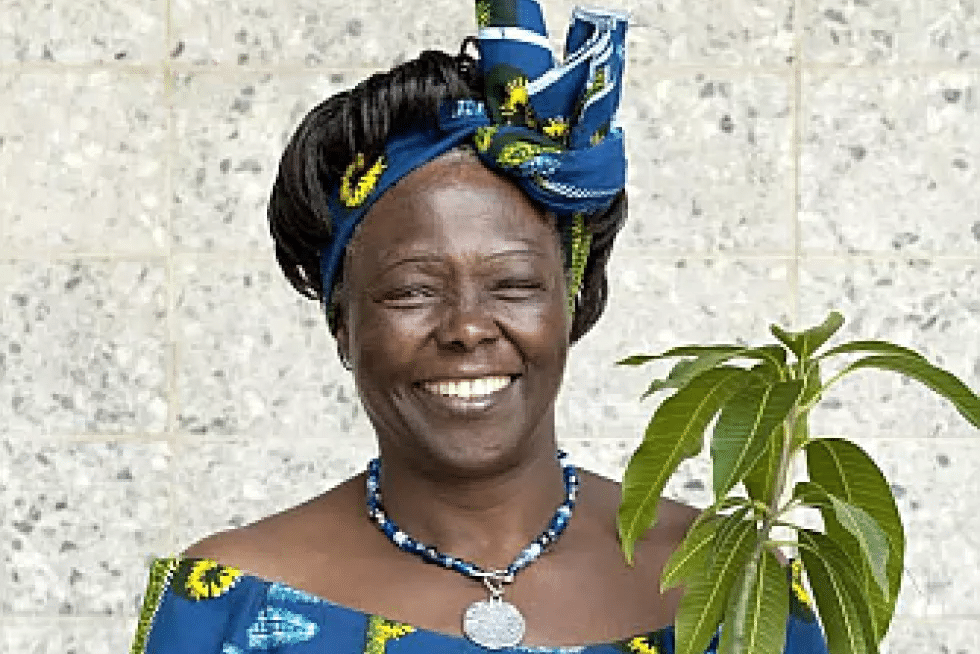
Women’s History Month Part 6: Wangari Maathai: The Woman Who Planted Trees and Empowered a Nation

image (23)

Every generation produces individuals whose work reshapes how the world understands justice, responsibility, and leadership. During Women’s History Month, it is important to recognize women whose contributions extend beyond their own communities and influence global conversations about equality, sustainability, and human rights. One of the most influential figures to emerge from Africa in the modern era is Wangari Maathai, the Kenyan environmentalist who transformed a grassroots tree-planting effort into an international movement for environmental protection, democracy, and women’s empowerment.

Born in rural Kenya in 1940, Maathai grew up witnessing the close relationship between people and the land. Farming communities depended on forests, water sources, and fertile soil for survival. Over time, however, rapid deforestation and environmental degradation began to threaten these resources. For many families, especially women who were responsible for gathering firewood and maintaining household livelihoods, the impact was immediate and severe.

Rather than accept this decline as inevitable, Maathai responded with action. In 1977, she founded the Green Belt Movement, a grassroots organization that mobilized rural women to plant trees across Kenya. What began as a modest effort quickly expanded into one of the most influential environmental initiatives in Africa. The movement helped restore forests, create economic opportunities for women, and encourage citizens to speak out against political injustice.

Her work gained international recognition in 2004 when she became the first African woman to receive the Nobel Peace Prize for her contribution to sustainable development, democracy, and peace. Wangari Maathai’s story demonstrates how environmental stewardship, community leadership, and political courage can intersect to create lasting change. This article examines her early life, the creation of the Green Belt Movement, the political challenges she faced, and the global impact of her work.

Early Life and Education

Wangari Maathai was born on April 1, 1940, in Nyeri, Kenya, in a farming family that relied heavily on the natural environment for food and income. Growing up in a rural setting allowed her to observe firsthand how healthy forests, clean water, and fertile soil sustained entire communities.

Her early education took place during a transformative period in Kenya’s history, as the country was moving toward independence from British colonial rule. Despite social and economic barriers that often limited educational opportunities for girls, Maathai excelled academically. She eventually received the opportunity to study in the United States as part of a scholarship program for East African students.

During her time in the United States, she earned a bachelor’s degree in biology and later completed a master’s degree. Exposure to global ideas about science, civil rights, and democratic governance shaped her perspective and strengthened her commitment to community service. When she returned to Kenya in the mid-1960s, she continued her academic journey and became the first woman in East and Central Africa to earn a doctorate degree in biology. She later became the first female professor at the University of Nairobi.

These accomplishments were significant not only for her personal career but also for the broader movement toward women’s participation in higher education and leadership. Yet Maathai soon realized that academic success alone would not solve the environmental and economic challenges facing Kenyan communities.

The Environmental Crisis Facing Rural Kenya

By the 1970s, Kenya was experiencing widespread deforestation. Forests were cleared for commercial agriculture, development, and fuel. While these activities supported certain industries, they also disrupted ecosystems and reduced access to basic resources for rural populations.

For many women living in villages, the consequences were immediate. Firewood became scarce, forcing women to walk longer distances to collect fuel for cooking. Streams that once provided clean water began to dry up. Soil erosion made farming more difficult, reducing crop yields and increasing poverty.

Maathai recognized that these environmental problems were closely tied to economic and social conditions. Women were often the first to notice environmental decline because their daily responsibilities depended on natural resources. Yet they rarely had access to the decision-making processes that shaped land use and environmental policies.

This realization became the foundation for Maathai’s most influential initiative.

The Creation of the Green Belt Movement

In 1977, Wangari Maathai launched the Green Belt Movement, a grassroots effort designed to address environmental degradation while empowering rural women. The concept was simple but powerful: women would plant trees in their communities to restore forests, protect water sources, and generate income.

The movement provided seedlings and training to women’s groups across Kenya. Participants learned how to establish small tree nurseries and care for young plants. Women were also paid a modest amount for each tree that survived, creating a direct economic incentive for environmental conservation.

What started as a local project quickly expanded nationwide. Women planted trees on farms, along roadsides, near schools, and around churches. Over time, the movement contributed to the planting of tens of millions of trees across Kenya.

Beyond environmental restoration, the Green Belt Movement created new opportunities for leadership and financial independence among women. Participants gained organizational skills, income, and a stronger voice in community decisions. The initiative demonstrated that environmental protection could also serve as a pathway to economic stability and social empowerment.

Environmental Protection and Political Activism

As the Green Belt Movement grew, Maathai began to address broader political issues affecting environmental management in Kenya. She argued that environmental destruction often occurred when governments lacked transparency and accountability.

During the 1980s and 1990s, she became increasingly vocal about government policies that threatened public lands and forests. One of the most well-known examples occurred in 1989 when plans were announced to construct a large commercial complex in Nairobi’s Uhuru Park. Maathai organized protests and public campaigns opposing the project, arguing that the park was an essential public space for the city.

Despite facing criticism, intimidation, and even physical assault during protests, she continued to advocate for environmental protection and democratic governance. Her activism linked environmental stewardship with political accountability, emphasizing that citizens must be able to participate in decisions about natural resources.

These actions often placed her in direct opposition to Kenya’s political leadership at the time. Yet her determination attracted international attention and support from environmental and human rights organizations around the world.

A Role in Government and International Leadership

Kenya’s political climate began to shift in the early 2000s as democratic reforms gained momentum. In 2002, Wangari Maathai was elected to Kenya’s National Assembly with overwhelming support from voters in her district. The following year she was appointed assistant minister for environment, natural resources, and wildlife.

Her role in government allowed her to advance policies supporting conservation and sustainable development. She continued to promote tree planting, environmental education, and responsible land management throughout Kenya.

At the same time, Maathai became a prominent voice in international environmental discussions. She spoke at global conferences, collaborated with environmental organizations, and encouraged governments to recognize the link between environmental protection and long-term economic stability.

The Nobel Peace Prize and Global Recognition

In 2004, Wangari Maathai received one of the world’s highest honors when she was awarded the Nobel Peace Prize. The Norwegian Nobel Committee recognized her work in promoting sustainable development, democracy, and peace.

Her award marked a historic moment, as she became the first African woman to receive the Nobel Peace Prize. The recognition also highlighted the broader message behind her work: environmental protection is not only about nature but also about human dignity, justice, and stability.

By the time of the award, the Green Belt Movement had helped communities plant more than thirty million trees and inspired similar initiatives in other African countries. The organization also expanded its work to include environmental education, community advocacy, and campaigns to protect public land.

Maathai used the international platform provided by the Nobel Prize to encourage citizens and governments around the world to prioritize environmental sustainability and democratic participation.

A Lasting Legacy

Wangari Maathai passed away in 2011 at the age of seventy-one, but her influence continues to shape environmental and social movements worldwide. The Green Belt Movement remains active, continuing its mission of tree planting, community education, and environmental advocacy.

Her work demonstrated that meaningful change often begins at the community level. By empowering local citizens—especially women—she created a movement capable of addressing both environmental and social challenges.

In addition, Maathai helped redefine the role of environmental activism. She showed that conservation is closely connected to economic opportunity, human rights, and democratic governance. Her approach encouraged leaders around the world to consider environmental policy as part of a broader strategy for social development.

Today, millions of trees stand across Kenya as living reminders of her vision. But perhaps her greatest contribution lies in the example she set: one individual, guided by conviction and supported by community, can influence an entire nation.

Wangari Maathai’s life illustrates the power of determined leadership and grassroots action. What began as a small initiative encouraging women to plant trees grew into a global symbol of environmental justice and community empowerment.

Her work addressed urgent environmental challenges while also advancing women’s leadership, democratic participation, and economic opportunity. By linking these issues together, she created a model for sustainable development that continues to influence policymakers, activists, and community leaders around the world.

As we recognize women during Women’s History Month, Wangari Maathai’s legacy stands as a powerful reminder that environmental stewardship and social progress are deeply connected. Her example encourages individuals everywhere to take responsibility for the land, the communities, and the institutions that shape our shared future.

Thank you for taking the time to read and reflect. I write to help people think clearly about money, business, real estate, and life — not from theory, but from decades of lived experience.

If you are navigating a financial decision, building a business, considering homeownership, or simply trying to make better use of your time and resources, I invite you to engage further.

Subscribe to The Power Is Now TV to connect with me live every weekday, Monday through Friday, from 10:00 AM to 11:00 AM PST, as we record television shows across the Power Is Now TV Network. As a subscriber, you can participate in live tapings, engage in real-time discussions, and connect directly with industry leaders.

Visit ThePowerIsNow.com to access real estate magazines, books, podcasts, television shows, and exclusive media content focused on homeownership, business, and wealth-building.

For personalized support, consulting, and advisory services in real estate, mortgages, business, and personal finance, visit EricFrazier.com to schedule a consultation and learn more about my work as your trusted advisor in business and wealth.

Eric Lawrence Frazier, MBA
Your trusted advisor in business and wealth
www.ericfrazier.com | www.thepowerisnow.com
NMLS #451807 | CA DRE #01143484
Schedule a consultation:
https://calendly.com/ericfrazier/real-estate-mortgage-consultation-clients


Research & Sources