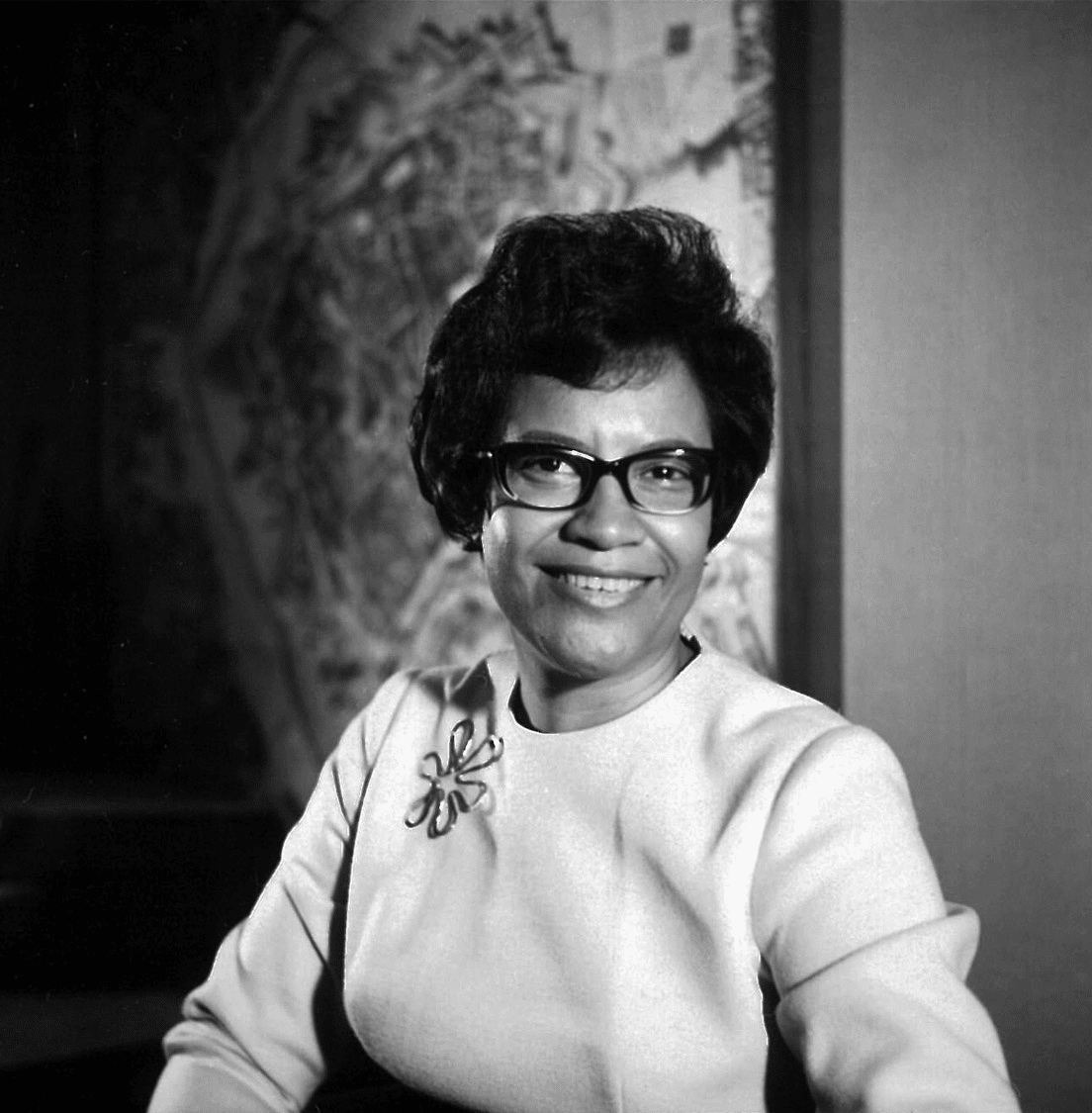
Women’s History Month Part 7: Norma Merrick Sklarek: She Built the Buildings. The Industry Kept Her Name Off Them.

image (24)

There is a terminal at Los Angeles International Airport that Norma Merrick Sklarek built. There is an American embassy in Tokyo that Norma Merrick Sklarek designed. There is a Pacific Design Center in Los Angeles, a California Mart, a San Bernardino City Hall, a Fox Plaza in San Francisco, and a Mall of America in Bloomington, Minnesota, that exist in significant part because of her work. You may have walked through one of them. You almost certainly did not know whose hands brought it into existence.

That invisibility — the gap between the work she did and the credit the profession assigned her — is not incidental to her story. It is the story. Norma Merrick Sklarek spent four decades executing some of the most consequential architectural projects in the United States while the industry she served categorized her as “project architect” rather than “design architect,” a distinction that kept her name out of the publications, the awards, the history books, and the popular memory of American architecture. The buildings stood. She did not.

She was born on April 15, 1926, in Harlem, New York, the only child of Dr. Walter Ernest Merrick and Amy Merrick, both immigrants from Trinidad. Her father was a physician. Her mother was a seamstress. They had arrived in the United States as part of the first significant Caribbean immigration wave of the early twentieth century, in the year before her birth, carrying with them the conviction that education and professional achievement were the mechanisms of a better life. That conviction was transmitted to their daughter without ambiguity.

She grew up in Harlem and Brooklyn, attending predominantly white schools where, by her own account, teachers and fellow students regarded her as an inferior human being. She resolved, during those years, to prove them wrong. Her aptitude for mathematics and art was clear early. Her father — with whom she was close, who took her fishing and taught her carpentry and house painting — recognized the combination and suggested architecture. In the 1940s, suggesting that a Black girl from Harlem pursue architecture was not a modest ambition. It was an act of deliberate defiance against what the world had arranged for her.

Nineteen Rejections. One Exam. One Industry That Had No Idea What Was Coming.

She attended Barnard College for one year — the minimum liberal arts requirement for admission to Columbia University’s School of Architecture — and then enrolled at Columbia. The School of Architecture in the late 1940s was dominated by World War II veterans, many of them holding advanced degrees, who formed exclusive study groups among themselves and collaborated on assignments. Sklarek commuted to school. She studied alone, on the subway,y and at home. There were no study groups that included her. She described the environment plainly: “The competition was keen. But I had a stick-to-it attitude and never gave up.”

She graduated in 1950 with a Bachelor of Architecture — the first Black woman to earn an architecture degree from Columbia, one of only two women in her graduating class. She then applied to nineteen architectural firms in New York City. All nineteen rejected her. Her own account of what drove those rejections, delivered in 2004, was precise in its refusal to choose between the two explanations the industry offered: “They weren’t hiring women or African Americans, and I didn’t know which it was working against me.” The answer, of course, was both. But the industry preferred not to name either, and so Norma Merrick Sklarek — Columbia-trained, architecturally gifted, possessed of a degree the nineteen firms’ hiring partners could not dispute — accepted a civil service position as a junior draftsperson at the New York City Department of Public Works.

She stayed four years. She was dissatisfied from the start. In 1954, she sat for the New York State architecture licensure examination — a grueling four-day ordeal that separated licensed architects from everyone else in the profession. She passed on her first try. She became the first Black woman to hold an architecture license in the state of New York. Within a year, armed with a license that made her institutional credentials undeniable, she applied again to the private firms. This time, me Skidmore, Owings & Merrill — one of the most prominent architectural practices in the country — hired her. It did so despite a deliberately negative reference from her supervisor at the Department of Public Works, whose motivation she identified without hesitation: “It had to be personal. He was not a licensed architect, and I was a young kid — I looked like a teenager — and I was black and a licensed architect.”

At SOM, she received real responsibility for large-scale projects. She was, simultaneously, a single mother of two sons, working with her mother serving as primary childcare, and teaching evening architecture courses at New York City Community College. She did all of this without apparent complaint because complaint, in her framework, was not the instrument. The work was the instrument. In 1959, she became the first Black woman member of the American Institute of Architects. In 1960, she accepted the position of first female vice president at Gruen Associates in Los Angeles. In 1962, she became the first Black woman licensed as an architect in the state of California. She was building the record of a woman who was, by any professional measure, at the top of her field. The field did not always acknowledge it.

The Credit Problem. And What It Tells You About How Architecture Actually Works.

In 1975, Norma Merrick Sklarek wrote a letter to the vice chancellor at UCLA, where she was serving on the architecture faculty. The letter contains one of the most precise and quietly devastating sentences in the documentary record of Black professional life in twentieth-century America. She wrote: “As far as I know, I am the first and only Black woman architect licensed in California. I am not proud to be a unique statistic, but embarrassed by our system, em which has caused my dubious distinction.”

That sentence was not bitter. It was analytical. She was not cataloguing her suffering. She was naming a structural condition and locating the responsibility for it correctly: not in her own inadequacy, not in some natural order of things, but in a system that had produced an outcome it ought to have been embarrassed by. She had been a licensed California architect for thirteen years when she wrote that letter. She had been at Gruen Associates for fifteen years, rising to Director of Architecture, responsible for hiring and supervising staff architects and coordinating technical aspects of major projects. And she was still, as far as she knew, the only one.

The projects she executed at Gruen during those two decades were not minor commissions. The California Mart is a 2.5 million square foot fashion and trade center in Los Angeles. The Fox Plaza in San Francisco. The San Bernardino City Hall. The Pacific Design Center. The United States Embassy in Tokyo, which she co-designed with César Pelli. Pelli received the primary public credit for the Embassy. Sklarek was largely invisible in its public attribution, despite having been responsible for both design work and the supervision and hiring of staff on the project. This was not an accident or an oversight. It was the operating logic of an industry that consistently designated women architects as “project architect” — the person who manages the execution — rather than “design architect” — the person whose name appears in the publications and the prize citations. The distinction was systematically applied to women. It was systematically not applied to their male counterparts doing equivalent work.

I have spent thirty-five years in real estate and mortgage banking. I understand the credit problem from a different industry, but the same structural logic. There is a version of this in lending: the loan officer who builds the client relationship, structures the deal, solves the underwriting problems, and closes the transaction — and then watches someone else’s name on the organizational chart receive the institutional recognition. The mechanism is the same. The work happens at one level. The credit accumulates at another. And the people most systematically denied the credit are, in both industries, the people the institution never fully accepted as belonging there in the first place.

Terminal One Was the Only One That Finished on Time. She Never Said It Loudly.

In May 1978, the International Olympic Committee awarded the 1984 Summer Games to Los Angeles. The Los Angeles Department of Airports immediately confronted a problem: the city’s international airport could not handle the volume of travelers the Olympics would bring. A $700 million renovation program was launched. Multiple terminals and infrastructure projects were commissioned simultaneously, all with the same hard deadline: the summer of 1984.

Welton Becket Associates was hired to build Terminal One — a $50 million domestic passenger terminal. Norma Merrick Sklarek had joined Welton Becket on January 1, 1980, as vice president — the first female licensed architect in the firm’s history, and the first hired to a senior position. She was fifty-three years old, a licensed architect in two states, a twenty-year veteran of one of the major firms in Los Angeles, and the first African American woman elected to the College of Fellows of the American Institute of Architects, the profession’s highest honor, which she had received that same year. She was handed the most time-sensitive construction project in the city’s history.

She delivered it. Terminal One became operational on January 23, 1984 — ahead of schedule. Every other Olympic-related project at LAX was in serious difficulty. Multiple projects were missing deadlines, losing ground, and descending into the administrative chaos of large-scale construction mismanagement. Eventually, the airport manager — who had initially walked into his first meeting with Sklarek carrying what her son David Merrick Fairweather later described as “incredible prejudice” — had to come to Sklarek and ask her to help get other projects’ plans through the building department. She helped. She has said of that period: “We all had the same types of problems to deal with, but somehow I was able to avoid slipping into the potholes and going under.”

One month after Terminal One opened, her husband Rolf Sklarek — a Bauhaus-trained architect she had met at Gruen Associates and married in 1967 — died. She had completed the largest project of her professional life and buried her husband in the same month. She did not make a public performance of either.

The Largest Women-Owned Firm in the Country. And What the Industry Did With That.

In 1985, Norma Merrick Sklarek co-founded Siegel Sklarek Diamond with Margot Siegel and Katherine Diamond. It was, at the time of its founding, the largest women-owned architectural firm in the United States. Sklarek was the first African American woman to co-own an architectural firm. The firm’s opening performance was, by any measure, extraordinary: it submitted proposals on five projects and won all five commissions.

Then the industry’s structural logic asserted itself. The commissions that came to Siegel Sklarek Diamond were not the commissions that came to firms led by white men. They were smaller. Primarily residential and commercial remodeling. Civic additions. Institutional renovations. The Tarzana Promenade is a 90,000-square-foot medical and retail center. Remodeling of the Lawndale Civic Center. Student facilities at UC Irvine. These were real projects, executed with the same discipline Sklarek brought to everything she touched. But they were not the scale of work she had been doing for twenty years. The commissions for airports, embassies, trade centers, and urban design centers — the work that built reputations and generated the fees that sustained large practices — did not materialize for a women-owned firm in 1985 in the way they materialized for other firms.

She left in 1989. She has said she missed the challenges and income of large-scale work. That sentence, read carefully, contains an entire structural argument about what women-owned firms in architecture were permitted to become, and the gap between the institutional recognition those firms received and the talent that had founded them.

She joined the Jerde Partnership in 1989 as principal of project management. Her most significant project there was the Mall of America in Bloomington, Minnesota, which, at its opening, was the largest shopping and entertainment complex in North America. She retired from practice in 1992. She then spent the rest of her working life doing what the profession had needed her to do from the beginning: teaching at Howard University and Columbia University, mentoring minority and women architects, serving as the role model she had never had. Marshall Purnell, former president of the AIA, has credited her directly. Katherine Diamond, her co-founder at Siegel Sklarek Diamond, has credited her directly. She created, through her example and her deliberate investment in younger architects, a lineage that the profession had no intention of producing on its own.

The Rosa Parks of Architecture Built Terminals and Embassies. We Owe Her the Name.

AIA board member Anthony Costello called her “the Rosa Parks of architecture” when she received the AIA Whitney M. Young Jr. Award in 2008. The comparison is apt in a specific sense: Rosa Parks did not simply sit down on a bus. She was a trained activist, a meticulous strategist, a person who understood the system she was challenging and who chose her moment with precision. Norma Merrick Sklarek did not simply persist in a hostile profession. She mapped it, navigated it, executed inside it at the highest level it offered, and then spent her retirement years ensuring that the people coming behind her had what she had been denied: a visible example, a name they could point to, evidence that the door could be walked through.

The record of firsts she accumulated across four decades is so dense it begins to read like a structural critique of the profession rather than a biography of a single person. First Black woman to earn an architecture degree from Columbia. First to hold a license in New York. First to hold a license in California. First Black woman member of the AIA. First African American woman elected to the AIA College of Fellows. First female vice president at Gruen. First female licensed architect at Welton Becket. First African American woman to co-own an architectural firm. Each of those firsts is not a personal achievement in isolation. Each is a data point in the argument that the architecture profession was, by design, organized to exclude her.

She was appointed to the California Architects Board in 2003 by the state governor and served on its Professional Qualifications Committee and Regulatory Enforcement Committee. She chaired the AIA National Ethics Council. She served as director of the Los Angeles AIA chapter. She was posthumously awarded the AIA/LA Gold Medal in 2019. Howard University named its architectural scholarship award after her. The California State Legislature issued a resolution in her honor in 2007. The Smithsonian National Museum of African American History and Culture holds her archival collection.

She died on February 6, 2012, in Pacific Palisades, California. She was eighty-five years old. Her son, David Merrick Fairweather, an attorney, survived her. Her son Gregory Merrick Ransom had predeceased her in 2006. Her husband, Dr. Cornelius Welch, survived her.

She left behind a letter, written in 1975, in which she said she was embarrassed by a system that had made her a unique statistic. She was right to be embarrassed on the system’s behalf. She was also, characteristically, directing the embarrassment at exactly the right address: not at herself, not at the difficulty of her path, but at the machinery that produced the path in the first place. That clarity — about where the problem actually resided — is as precise and as useful in 2025 as it was fifty years ago.

Thank you for taking the time to read and reflect. I write to help people think clearly about money, business, real estate, and life — not from theory, but from decades of lived experience.

If you are navigating a financial decision, building a business, considering homeownership, or simply trying to make better use of your time and resources, I invite you to engage further.

Subscribe to The Power Is Now TV to connect with me live every weekday, Monday through Friday, from 10:00 AM to 11:00 AM PST, as we record television shows across the Power Is Now TV Network. As a subscriber, you can participate in live tapings, engage in real-time discussions, and connect directly with industry leaders.

Visit ThePowerIsNow.com to access real estate magazines, books, podcasts, television shows, and exclusive media content focused on homeownership, business, and wealth-building.

For personalized support, consulting, and advisory services in real estate, mortgages, business, and personal finance, visit EricFrazier.com to schedule a consultation and learn more about my work as your trusted advisor in business and wealth.

Eric Lawrence Frazier, MBA
Your trusted advisor in business and wealth
www.ericfrazier.com | www.thepowerisnow.com
NMLS #451807 | CA DRE #01143484
Schedule a consultation: https://calendly.com/ericfrazier/real-estate-mortgage-consultation-clients


Research & Sources