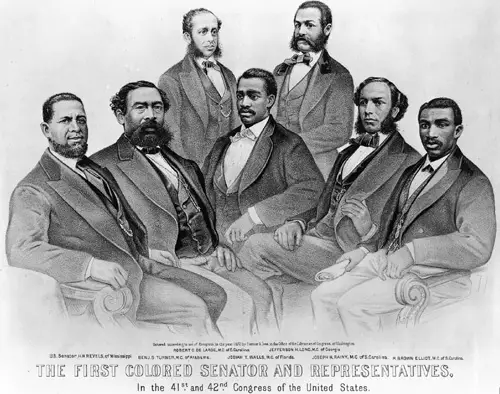
The First Keepers of the Claim: Hiram Revels, Joseph Rainey, and the Black Men Who Entered Congress While Slavery Was Still Breathing

47a

Juneteenth is not merely a celebration of freedom. It is the record of freedom delayed, freedom withheld, freedom announced only after power had been forced to surrender what it never had the moral right to possess. That is why Juneteenth and reparations cannot be separated. One remembers the announcement. The other demands the settlement.

In 1865, the legal institution of slavery was defeated. By 1870, Hiram Rhodes Revels of Mississippi stood in the United States Senate as the first African American senator, and Joseph Hayne Rainey of South Carolina stood in the House of Representatives as the first African American member of that chamber. Five years after emancipation, Black men entered the Congress of the United States. Not fifty years. Not a century. Five years. Men born under or near the shadow of slavery stood in the rooms of federal power representing a people this nation had bought, sold, whipped, hunted, counted, taxed, excluded, and exploited. Their presence was not decoration. Their presence was evidence.

America did not send them into a healed republic. America sent them into a republic still contaminated by the same Confederate spirit that had just lost the war and was already preparing to win the aftermath. The battlefield had changed, but the philosophy had not died. Slavery had fallen as law, but white domination immediately began searching for new instruments: Black Codes, racial terror, voter suppression, land restoration to former Confederates, convict leasing, segregated education, and the slow suffocation of Reconstruction. The nation that had been forced to release Black bodies still had no intention of repairing Black lives.

Revels and Rainey were not modern reparations legislators. They were the first federal witnesses of Black citizenship after slavery. Their fight was survival. Their fight was protection. Their fight was education, voting rights, federal enforcement, and the right of Black people to exist as political beings in a country that had spent centuries denying their humanity. Before Black America could demand payment, Black America had to survive the campaign to make freedom meaningless.

That is the first truth of the reparations claim. The claim did not begin with a check. It began with survival. It began with Black people insisting that emancipation was not enough if the nation returned them to the mercy of the same people who had enslaved them. It began with the understanding that freedom without land, wages, safety, schools, credit, and federal protection was freedom left exposed in the street.

The federal government understood compensation. That must be stated without apology. The United States knew how to calculate loss when the claimant was the enslaver. In 1862, when slavery was abolished in Washington, D.C., the federal government compensated loyal slaveholders up to $300 for each freed person. The money went not to the enslaved, but to those who had claimed ownership over them. America did not find compensation radical when the person being compensated was the one who had profited from bondage. Compensation became controversial only when the moral logic pointed toward the enslaved.

The Freedmen’s Bureau, created in 1865, also reveals what the government knew. The Bureau was established to aid formerly enslaved people and manage abandoned or confiscated lands. The government knew land mattered. It knew property mattered. It knew that emancipation without economic foundation would leave millions of Black people vulnerable to dependency, violence, and exploitation. Then the promise was betrayed. Land was restored to former Confederates, and the formerly enslaved were left to build lives in a country that had taken everything from them and then acted offended when they asked for anything back.

That betrayal is the soil from which every later reparations demand grows. Black people were not asking for charity. They were asking for the unpaid portion of freedom. They were asking for the economic substance that should have followed legal emancipation. They were asking for what the federal government had already proven it could provide when it cared to provide it: recognition, administration, calculation, and compensation.

The tragedy of Reconstruction is not that Black people failed. Black people organized, voted, held office, built schools, formed communities, purchased land where possible, and entered public life with a courage that should shame every generation that now treats democracy as an occasional errand. Reconstruction failed because America allowed white power to regroup. It failed because the federal government withdrew protection before justice had taken root. It failed because the nation preferred reconciliation with former Confederates over restitution for formerly enslaved people.

Hiram Revels and Joseph Rainey stand at the beginning of this series because they represent the first keepers of the claim. They did not carry H.R. 40. They carried something more primitive and more dangerous to white power: the visible contradiction of Black citizenship in a nation built on Black enslavement. They stood in Congress before America had decided whether emancipation would mean a new social order or merely a rearranged plantation.

John Conyers would come more than a century later and give the claim a bill number. Sheila Jackson Lee and Ayanna Pressley would carry it into another generation. Barack Obama would stand inside the highest office in the land and still leave the claim untouched. But Revels and Rainey came first. Their presence in Congress was the beginning of the federal record. They proved that Black people had survived slavery. Their era proved that survival was not repair.

Juneteenth announces freedom delayed. Reconstruction reveals repair denied. The first Black men in Congress carried the testimony of a people who had been legally emancipated but economically abandoned. America changed the legal status of Black people, then refused to settle the account.

That refusal is the beginning of the debt.

Thank you for taking the time to read and reflect. I write to help people think clearly about money, business, real estate, and life — not from theory, but from decades of lived experience.

If you are navigating a financial decision, building a business, considering homeownership, or simply trying to make better use of your time and resources, I invite you to engage further.

Subscribe to The Power Is Now TV to connect with me live every weekday, Monday through Friday, from 10:00 AM to 11:00 AM PST, as we record television shows across the Power Is Now TV Network. As a subscriber, you can participate in live tapings, engage in real-time discussions, and connect directly with industry leaders.

Visit ThePowerIsNow.com to access real estate magazines, books, podcasts, television shows, and exclusive media content focused on homeownership, business, and wealth-building.

For personalized support, consulting, and advisory services in real estate, mortgages, business, and personal finance, visit EricFrazier.com to schedule a consultation and learn more about my work as your trusted advisor in business and wealth.

Poetry says the rest 

References

Eric Lawrence Frazier, MBA
Your trusted advisor in business and wealth
www.ericfrazier.com | www.thepowerisnow.com
NMLS #451807 | CA DRE #01143484
Schedule a consultation: https://calendly.com/ericfrazier/real-estate-mortgage-consultation-clients