A Second Reflection on Memory, History, and the American Conscience
By Eric Lawrence Frazier, MBA
After publishing my first essay on the recent Supreme Court rulings involving the Voting Rights Act of 1965, I continued thinking about what had happened and about my own reaction to it. I kept asking myself where this country is going. Does America remember why we had the Voting Rights Act in the first place? Do our elected officials remember? Do the courts remember? More importantly, do ordinary Americans remember what African Americans actually experienced in this country before these protections were passed into law?
My original assumption was that people already understood this history. I assumed most Americans knew why the Voting Rights Act became necessary. I assumed people understood what conditions existed before 1965 and why the federal government finally concluded it had to intervene directly in state election systems. But the more I talked about it with family and friends, the more it became evident to me that many people simply do not know the history well enough to understand what is happening now.
That realization changed the direction of this essay completely. So I decided to focus on explaining this history, especially for younger generations who may have heard the phrase “Voting Rights Act” but certainly do not know much about Section 5 or Section 2. In my first article I wrote with the assumption that everybody already understood that history, and that simply is not the case.
Because if people do not understand the conditions that produced the law, then they cannot possibly understand why so many people are alarmed as portions of that law continue to be weakened today. Perhaps we have forgotten. Or perhaps many Americans never truly knew.
Most Americans have heard reporters discuss the Voting Rights Act. They have heard political commentators argue about Sections 2 and 5. They have heard Supreme Court decisions discussed on television. But if you stopped many Americans on the street and asked them to explain what the law actually was, why it became necessary, or what was happening in America before it was passed, I seriously doubt many people could explain it clearly. We cannot intelligently discuss the dismantling of voting-rights protections if we first do not understand what America was like before those protections existed.
I have five grandchildren now. One is in the second grade, one is in the fourth grade, and one is in the sixth grade. I have two more grandchildren who have not started school yet. They are only one and two years old. The other three are not too young to understand fairness, injustice, exclusion, and basic human dignity.
As I started writing this essay, I realized that I do not want them to miss the opportunity to understand what is happening in this country while it is happening. I have a tremendous opportunity right now as a grandfather to explain these things to them while they are still young enough to build historical understanding into the foundation of how they see the world.
Children already understand one of the most important principles at the center of this entire conversation: fairness. Children know when they are being treated unfairly. They know when rules are uneven. They know when somebody is being excluded or mistreated. Anybody who has ever raised children already knows this because children constantly announce it to their parents: “That’s not fair.”
So if you explain to a child that there was a time in America when Black people could not freely vote, could not eat in certain restaurants, could not stay in certain hotels, could not attend certain schools, and could not even drink from the same water fountains as white Americans, most children immediately recognize that something is wrong with that picture, whereas adults sometimes do not because adults become conditioned by repetition. We hear historical facts repeated so casually that eventually we stop feeling the weight of what those facts actually mean.
To understand the Voting Rights Act, we first have to go back to the end of slavery itself. Slavery officially ended in the United States in 1865 after the Civil War. Then, in 1870, America passed the Fifteenth Amendment to the United States Constitution. The Fifteenth Amendment said states could not deny citizens the right to vote because of race or because they had previously been enslaved. In plain English, Black men were now officially supposed to have the constitutional right to vote. But having rights written on paper and being allowed to use those rights in real life are two completely different things.
Although African Americans technically had voting rights after 1870, many states — especially throughout the South — had absolutely no intention of allowing Black citizens to participate equally in American democracy. Slavery had ended, but the desire to maintain racial control had not ended. The belief in white superiority had not ended. The fear of Black political participation had not ended.So instead of openly saying “Black people cannot vote,” states created systems designed to make voting difficult, humiliating, dangerous, or almost impossible.
And all of this was happening during a period when segregation controlled almost every aspect of Black life. African Americans often could not eat in certain restaurants. They could not stay in certain hotels. They could not attend certain schools. They could not use certain public bathrooms. They drank from separate water fountains marked “Colored.” They sat in separate sections of buses and trains. In many cities Black families could not buy homes in white neighborhoods because banks, governments, and real estate companies blocked them systematically through redlining, racial covenants, lending discrimination, and intimidation.¹
Children today need to understand this clearly because segregation is often taught in sanitized language that makes it sound like a minor inconvenience rather than what it actually was: a complete social system designed to constantly remind African Americans that they were considered inferior and unwelcome in large parts of American society.
Voting restrictions became part of that larger system.
One method states used was called a poll tax. A poll tax meant citizens had to pay money before they could vote. Imagine telling poor families they must first pay a fee before being allowed to participate in democracy. Many African Americans after slavery were already economically trapped because generations of wealth had been stolen through slavery, discrimination, and exclusion from economic opportunity.
Another method was the literacy test. At first glance that may sound reasonable until you understand how these tests were actually used. White officials often decided who passed and who failed. White voters were frequently given simple questions or passed automatically, while Black voters were given impossible questions, confusing legal passages, or failed for tiny technicalities. The purpose was exclusion.
Then there were white primaries. Some political parties only allowed white citizens to vote in primary elections. Since the primary election often determined who would eventually win office in Southern states, Black citizens were effectively excluded from meaningful political participation before the general election even occurred.
Then there was intimidation. African Americans who attempted to register voters or organize politically could lose their jobs. Families could be threatened economically. Churches could be attacked. Homes could be burned. Some people were beaten. Some disappeared. Some were murdered. Voting was not merely difficult for many Black Americans. It was dangerous.
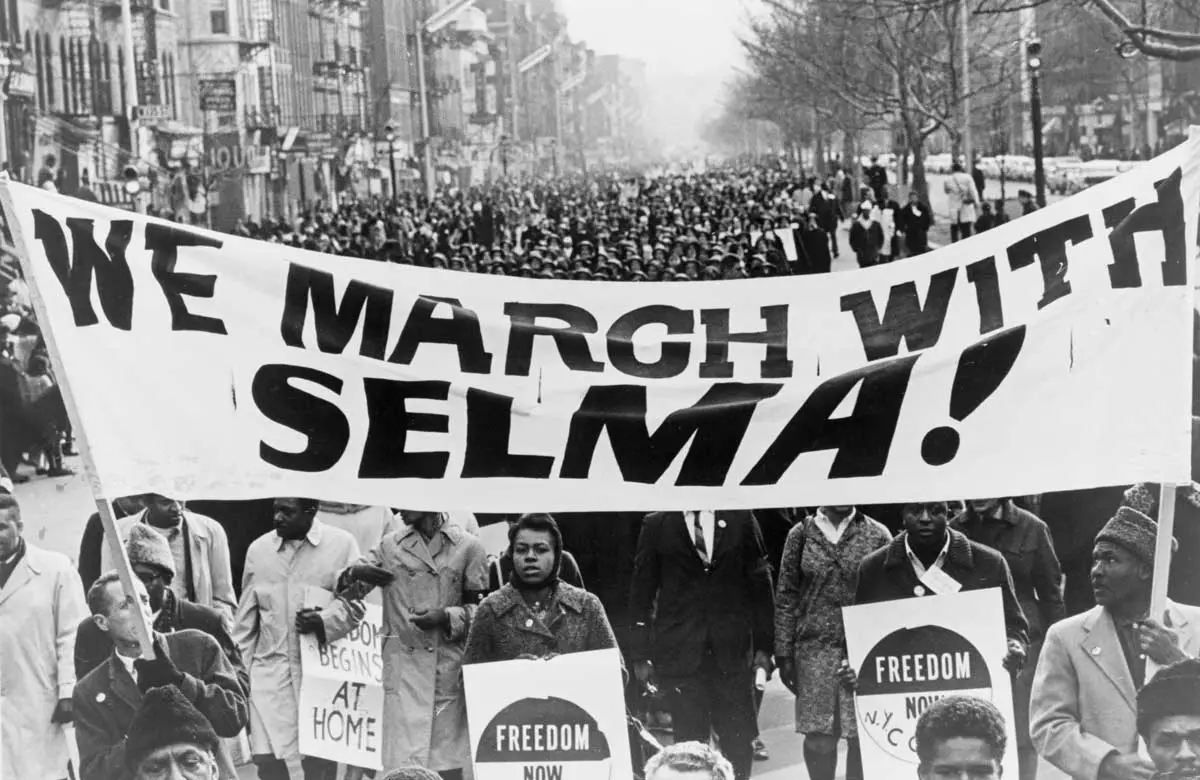
Then came Selma.
On March 7, 1965, around six hundred peaceful protesters attempted to march from Selma to Montgomery, Alabama, demanding voting rights and equal treatment under the law. As they crossed the Edmund Pettus Bridge, they were met by state troopers and local law-enforcement officers who brutally attacked them with clubs, tear gas, and violence in full public view. Men and women were beaten. Protesters were trampled. Blood covered the bridge in scenes that would soon be broadcast across the country on national television. The event became known as Bloody Sunday. Among the march leaders was future Congressman John Lewis, who suffered a fractured skull during the attack.
Americans watching television that night witnessed peaceful Black citizens being beaten simply for demanding the constitutional right to vote.
But another question enters my mind now. Why did it take Selma to shock the nation after centuries of brutality against African Americans? Why were Americans not shocked during slavery itself? Why were they not shocked during the lynchings, the burnings, the public beatings, and the decades of segregation and humiliation?
Black suffering was normalized in this country for a very long time. Selma mattered because America finally saw publicly what African Americans had already been experiencing privately for generations.
Just days after Bloody Sunday, President Lyndon B. Johnson addressed Congress and called for strong voting-rights legislation.² A few months later, on August 6, 1965, the Voting Rights Act became law.³
The law was not passed in a vacuum. It was passed because the country could no longer publicly deny what had been morally visible for generations.
One of the most important parts of the law became known as Section 5. Section 5 required certain states and counties with long histories of racial discrimination to obtain federal approval before changing voting laws or election procedures. This process became known as preclearance.⁴
Another important section became known as Section 2. Section 2 prohibited voting practices that discriminated based on race nationwide.
This is why recent Supreme Court rulings concern me so deeply. Portions of the enforcement structure created to protect voting rights are being weakened piece by piece. Some protections technically remain on paper, but the ability to enforce those protections becomes weaker, slower, and harder.
History teaches us something very important about rights. Rights that cannot be enforced eventually become symbolic.
America already learned that lesson once after the Fifteenth Amendment.
As I sit here dictating this essay into my phone — because that is how I write these days — I find myself reflecting on my own educational journey regarding the history of my community and my country.
In high school and college, I really did not like history very much. I thought it was boring and unnecessary because all I really wanted to know was what I needed in order to make money, survive, move forward professionally, and build a future for myself.
What I did not understand then was how deeply the past controls the present and shapes the future.
I also did not understand that laws, neighborhoods, schools, wealth, policing, voting systems, banking systems, homeownership patterns, and political attitudes were all being built on foundations laid generations earlier.
Before I attended high school, I was part of the federal integration busing program in San Bernardino. I lived in Muscoy on the west side of San Bernardino near Macy Street, which at the time was considered a very rough neighborhood. I was bused across town to Golden Valley Junior High School on Waterman Avenue in the north end of San Bernardino. I was the only Black student in all of my classes.
Looking back on that experience now, I realize something that never fully occurred to me as a child: I was participating in American history while it was happening around me.
At the time, however, I did not fully understand what was happening or why it was happening. I did not understand segregation, federal court intervention, integration policy, or why Black children were being bused into predominantly white schools in the first place.
What stands out to me now is that none of it was ever carefully explained to me.
I was living inside one of the major social transformations in modern American history, yet I did not understand the larger historical forces shaping the moment while I was experiencing it.
I understand now that knowing your history may be one of the most important things a human being can do after learning how to read.
And here I am now at sixty-four years of age becoming a far more serious student of history than I ever was as a teenager or young adult. I pay close attention now to what is happening federally, politically, economically, culturally, and socially because I finally understand something younger people often do not yet fully grasp: history never completely disappears. It echoes forward. It leaves structures behind, attitudes behind, habits behind, and societies often continue repeating patterns long after people have forgotten where those patterns originally came from.
That is where I believe America is right now.
Now I have nobody to blame for becoming what I call a late history bloomer, but I am troubled by being late to the class. It troubles me personally when I think about the lack of engagement my parents and I had regarding political matters, historical events, and what was happening in the country while I was growing up under their care.
But as I think about it, I behaved very similarly with my own children.
My parents were busy trying to survive, trying to work, trying to keep food on the table and a roof over our heads. The same became true for me. I became so focused on building a career in mortgage banking and real estate, so focused on making a living and moving professionally forward, that I did not always slow down long enough to intentionally teach my children the historical realities shaping the world around them.
That still is not a valid excuse for parents.
Children rarely understand what knowledge they will desperately need later in life. Parents are supposed to teach anyway.
I do not want to continue that silence anymore.
So it starts now with my children even though they are grown, and it continues with my grandchildren while they are still young enough to build historical awareness into the foundation of how they understand the world.
That is one of the reasons I am writing these essays. Not simply to react politically to headlines, court rulings, or news cycles, but to leave behind understanding.
Because one of my greatest fears is that younger Americans are inheriting a country they do not fully understand historically.
That loss of historical memory is dangerous because once people forget why protections were created, they eventually become comfortable dismantling them.
We have been down this road before. It appears there is still more traveling on this road we are going to do. This is where we call upon our ancestors and the brilliance of resilience to come shining forth. We will find a way. We will continue to make sure our voices are heard and our voices and our votes are counted.
Poetry says the rest: https://thepowerisnow.com/the-voting-rights-act-part-2-have-we-forgotten-why-the-voting-rights-act-exists/
References & Footnotes: https://thepowerisnow.com/the-voting-rights-act-part-2-have-we-forgotten-why-the-voting-rights-act-exists-footnotes/
Thank you for taking the time to read and reflect seriously on the historical realities that continue shaping our nation today. I write not simply to react to headlines, but to help preserve memory, awaken historical consciousness, and encourage thoughtful conversations across generations.
Please share this essay with your family, your children, your grandchildren, your classrooms, your churches, and your communities. These conversations matter. History matters. Memory matters. And our willingness to confront truth honestly will determine what kind of future we leave behind.
Subscribe to The Power Is Now TV to connect with me live every weekday, Monday through Friday, from 10:00 AM to 11:00 AM PST, as we record television shows across The Power Is Now TV Network. As a subscriber, you can participate in live tapings, engage in real-time discussions, and connect directly with industry leaders.
Visit ThePowerIsNow.com to access real estate magazines, books, podcasts, television shows, and exclusive media content focused on homeownership, business, and wealth-building.
For personalized support, consulting, and advisory services in real estate, mortgages, business, and personal finance, visit EricFrazier.com to schedule a consultation and learn more about my work as your trusted advisor in business and wealth.
Eric Lawrence Frazier, MBA
Your trusted advisor in business and wealth
www.ericfrazier.com | www.thepowerisnow.com
NMLS #451807 | CA DRE #01143484
Schedule a consultation: https://calendly.com/ericfrazier/real-estate-mortgage-consultation-clients